Introduction: why a rigorous WMS decision framework matters
Choosing a warehouse management system (WMS) is often framed as a features race: which product has the most barcode scanning options, the deepest integration with an ERP, or the slickest user interface. In practice, the right decision blends operational fit, technical integration, and financial discipline to deliver measurable outcomes over a multi-year horizon. A structured approach helps avoid common missteps - like over-optimizing for a single process, underestimating change management, or selecting a vendor whose roadmap diverges from your long-term strategy. This article outlines a practical, editorially grounded framework to compare WMS options, quantify ROI, and plan a scalable global rollout. For readers focused on long-term value, the aim is a decision that lasts beyond the next software release cycle.
Section 1: start with your footprint and your must-haves
Effective WMS selection begins with a precise map of your current and desired future state. What you need in a warehouse in 2026 may differ markedly from 2016, especially as automation and remote operations grow. Two questions anchor any credible evaluation:
- What are the non-negotiable capabilities (receiving, put-away, picking, packing, outbound shipping, cycle counting, yard management, and labor management)?
- How will the system exchange data with adjacent systems (ERP, TMS, MES, WCS) and with automation layers (robotics, conveyors, voice, scan/RFID)?
As you quantify needs, balance today’s bottlenecks with tomorrow’s growth. A strong WMS should not only fix current inefficiencies but also enable new operating models - such as cross-dock, wave-picking, or distributed fulfillment - without a wholesale replacement of your IT stack. This emphasis on fit-for-purpose capabilities aligns with industry analyses that frame WMS selection around automation readiness and total cost of ownership rather than feature hunting alone. For a high-level view of how WMSs contribute to throughput, accuracy, and cost control, see industry discussions and practitioner guides from the Institute for Supply Management. (ism.ws)
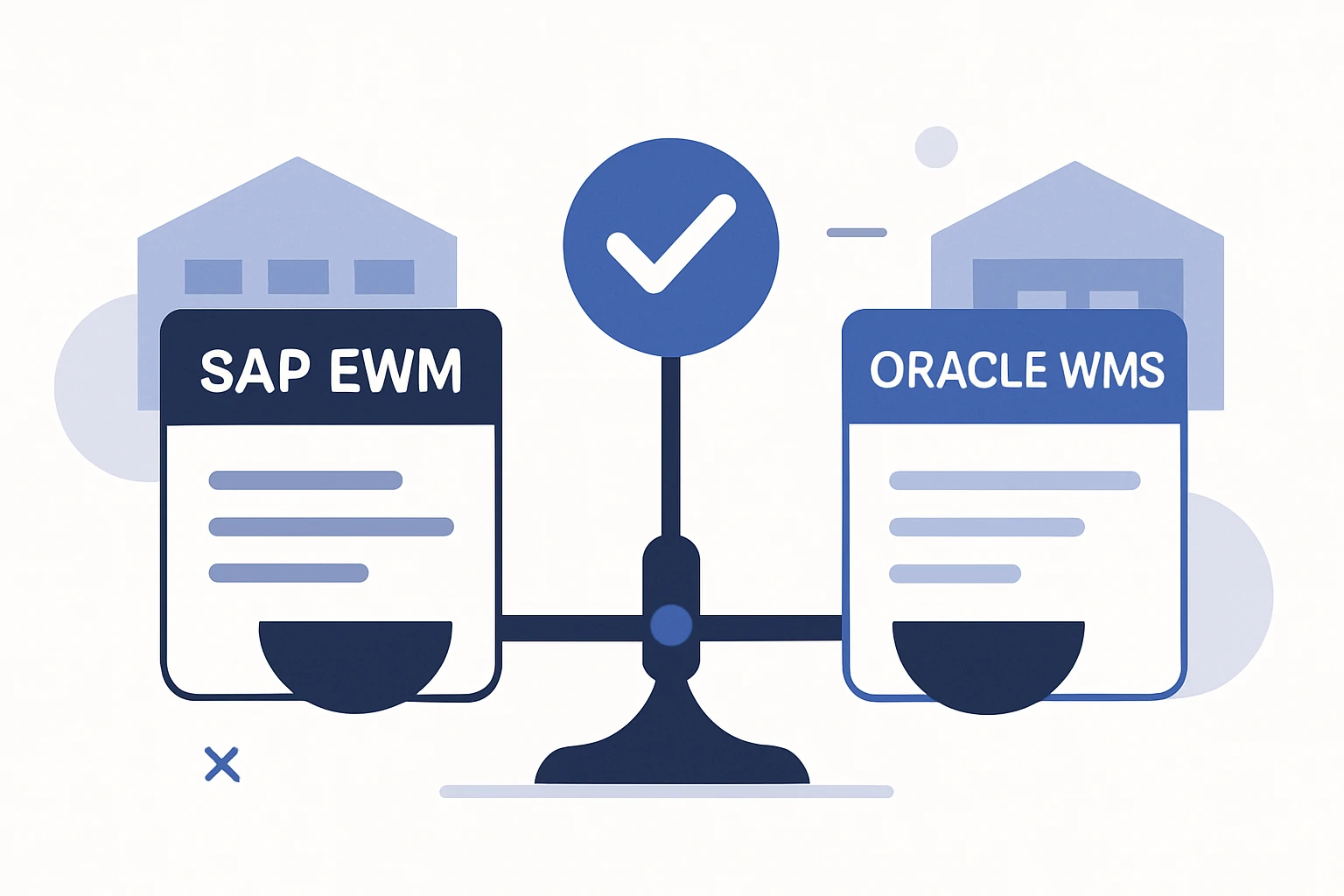
When comparing leading WMS options, two perennial contenders surface: SAP EWM and Oracle WMS. SAP EWM (Extended Warehouse Management) remains a cornerstone of SAP’s supply chain portfolio, with deep enterprise integration and a proven track record in complex, multi-site deployments. (sap.com) Oracle’s WMS offerings - whether on Oracle Cloud or on-premises - emphasize mobility, label/compliance support, and robust integrations within Oracle’s cloud ecosystem. (oracle.com)
Section 2: a practical framework to compare WMS vendors
To move beyond impressions, apply a three-dimensional framework that covers core functionality, integration readiness, and total cost of ownership. The following table provides a compact reference you can use during vendor shortlists. This is a structured way to document trade-offs and keep conversations anchored in business value.
| Dimension | What to Evaluate | Key Questions |
|---|---|---|
| Functionality | Core WMS capabilities, automation readiness, mobile/voice/RFID support, inventory control, and labor management | Does the system support multi-site operations, cross-docking, wave planning, slotting, and cycle counting at scale? |
| Integration & data flows | ERP/TMS/MES integration, data standardization, API strategy, and compatibility with automation stacks | Can it exchange data in real time with our ERP and with our robotics/voice platforms? What are the integration lead times? |
| Total cost of ownership & ROI | Capital expense, subscription/maintenance, upgrade cadence, and quantified benefits (throughput, accuracy, labor efficiency) | What is the payback period? How do maintenance and upgrade costs evolve over 5–7 years? |
Use this framework to create a side-by-side comparison document for internal stakeholders. It helps ensure that decisions are auditable, not just aspirational. Industry authority emphasizes that a structured evaluation - and attention to automation compatibility - drives successful deployments and cost efficiency. (gartner.com)
Section 3: ROI, TCO, and the value equation
ROI for a WMS is typically driven by improvements in inventory accuracy, labor productivity, and space utilization. Real-world benefits include faster put-away, fewer mis-picks, and better use of high-bay storage. A widely cited benefit of WMS adoption is higher inventory accuracy and improved throughput, which translate into lower write-offs, better customer service, and reduced overtime. Experts emphasize that ROI calculations should link process improvements to financial metrics such as gross margin, service levels, and capital utilization. For a concrete method to quantify ROI in warehousing projects, see ROI-focused materials and case studies referenced by industry practitioners. (ism.ws)
Many organizations build a simple ROI calculator for their WMS evaluation, modeling scenarios such as: impact of scanning adoption, labor reallocation, and space optimization. One vendor-agnostic example you’ll often encounter is the idea of an ROI calculator that lets teams input warehouse details (volume, lines picked per hour, labor costs) to estimate payback. While not a substitute for a full business case, such tools help structure executive-level discussions and scenario planning. (mobiledemand.com)
Section 4: limitations, trade-offs, and common mistakes
Even the best WMS project can underperform if it overlooks practical constraints. Three frequent issues:
- Underestimating change management: WMS adoption is as much about people and processes as it is about software. Training, user adoption, and process redesign matter as much as the technology itself.
- Overlooking data governance: Inconsistent master data and integration gaps create friction between WMS and ERP, diminishing the expected accuracy and velocity gains.
- Choosing a tool without automation maturity alignment: A less-automated WMS can become a bottleneck if you plan to scale with robotics, conveyors, or voice-driven picking. Align the vendor’s roadmap with your automation ambitions.
Industry perspectives echo these cautions, noting the importance of cloud/automation readiness and ergonomic user experiences as part of a sustainable WMS deployment. (gartner.com)
Section 5: vendor landscape in practice
A Gartner Magic Quadrant-style view highlights the competitive landscape, including major players like SAP, Oracle, and others, while underscoring the importance of automation, cloud options, and total-cost-of-ownership dynamics for modern warehouses. This market context helps buyers calibrate expectations about implementation effort, partner ecosystems, and product roadmaps. (gartner.com)
For readers who want a concrete product reference, SAP EWM (Extended Warehouse Management) is a mature, deeply integrated option within SAP’s supply chain portfolio, designed for complex, global deployments. Oracle WMS offers cloud-based and on-premises options with a strong focus on mobility and integration within Oracle’s ecosystem. Each product has distinctive strengths, the right choice depends on your tech stack, geographic footprint, and automation strategy. (sap.com)
Section 6: global rollout considerations and editorially grounded local realities
A global WMS rollout is not only about software, but also about regional readiness, localization, and governance. When operating across multiple countries, consider how local compliance, labeling standards, and language support interact with the universal logic of your warehouse processes. A staged rollout - initially validating core processes in a pilot DC, followed by phased geography expansions - helps manage risk and ensures operational stability as you scale. The vendor’s ability to support multi-site pilots, along with a robust upgrade path, becomes a decisive factor in the long run.
From a digital-asset perspective, scale often implies a parallel, strategic effort to manage regional branding and localization across web properties and corporate domains. For example, global teams sometimes need to build and manage regional digital footprints, such as country or language-specific domain portfolios. In practice, organizations look at formal assets like regional domain lists to inform localization, branding, and regulatory compliance. To illustrate how global teams think about digital footprint management, consider regional domain portfolios and related resources that catalog domain strategies across TLDs. For instance, a regional domain listing such as download list of .pe domains can be a useful internal reference when planning branding or web localization for a specific geography, while a broader resource like download list of domains by TLDs supports global brand governance. These references are provided here not as a product pitch but as contextual anchors for global rollout considerations within a logistics-tech program.
Practical domain-list references aside, the core lesson is clear: align global deployment with a deliberate organizational plan. This includes a clear implementation roadmap, a governance structure for data and interfaces, and a robust training program for warehouse teams. The right WMS choice should enable this alignment rather than complicate it.
Structured wrap-up: a concise implementation framework you can apply now
To help teams operationalize the concepts above, here is compact guidance you can bring to your next vendor workshop.
- Define scope. Map the two or three most critical use cases that must work in the first 90 days after go-live.
- Estimate ROI with a simple model. Quantify expected gains from improved accuracy, reduced overtime, and better space utilization.
- Plan integration. List data interfaces to ERP, TMS, and automation platforms, identify data standards and master data owners.
- Account for change. Build a training plan and change-management milestones into the project plan.
Conclusion: a choosing framework that ages well
Selecting a WMS is less about chasing the latest feature and more about choosing a platform that can scale with automation, support multi-site operations, and deliver measurable value over time. A disciplined evaluation framework - paired with a cautious view of ROI, and a realistic rollout plan - helps you avoid misfires and set your logistics program up for sustained success. As the market for WMS options evolves, the most successful buyers are those who connect vendor capabilities to strategic goals, and quantify the value in terms their CFO will recognize.
External references and vendor contexts in this piece are drawn from reliable industry sources and vendor literature, including SAP’s official EWM documentation and Oracle’s WMS materials, alongside market perspectives on warehouse management systems’ capabilities and ROI. (sap.com)