Introduction: the hard problem of choosing a WMS in a global supply chain
Global warehouses demand software that can scale, integrate with ERP, and deliver measurable benefits across receiving, putaway, picking, packing, and shipping. When executives ask for a warehouse management system comparison, they are really asking for a disciplined framework that separates hype from reality: which system fits our processes today, and how will it justify the investment over time? This article presents a practical view tailored to enterprises evaluating SAP EWM against Oracle WMS, while outlining a generic ROI framework and a data-diligence approach that keeps the process credible in a crowded market.
Key terms you will see include the ROI calculator concept, a structured vendor evaluation, and the need to ground assessment in real-world constraints rather than feature checklists alone. This isn’t a cheerleader piece for a single vendor, it is a decision guide grounded in current market realities and industry reporting.
Section 1: Core decision criteria for modern WMS deployments
Before comparing two leading options, teams should agree on a compact criteria set that translates into a scoring model. The most impactful dimensions typically include:
- Process fit and scalability across inbound, storage, order fulfillment, and outbound shipping
- ERP and ERP-cloud integration quality, data integrity, and master data governance
- Deployment model (cloud vs on-premises) and the pace of innovation
- Operational visibility: real-time inventory, slotting, and task interleaving
- Implementation risk, total cost of ownership, and migration path
Market observers emphasize that a leading WMS often becomes a strategic platform tied to broader digital transformation. For example, SAP EWM is designed to integrate with SAP S/4HANA and other SAP Logistics components, enabling seamless processes across the extended supply chain. Learn more about SAP EWM. (sap.com)
In parallel, cloud-native WMS options from Oracle emphasize multi-site, multi-warehouse capabilities with scalable cloud infrastructure. Oracle Warehouse Management Cloud overview. (oracle.com)
Section 2: SAP EWM vs Oracle WMS - what each brings to modern warehouses
SAP Extended Warehouse Management (EWM)
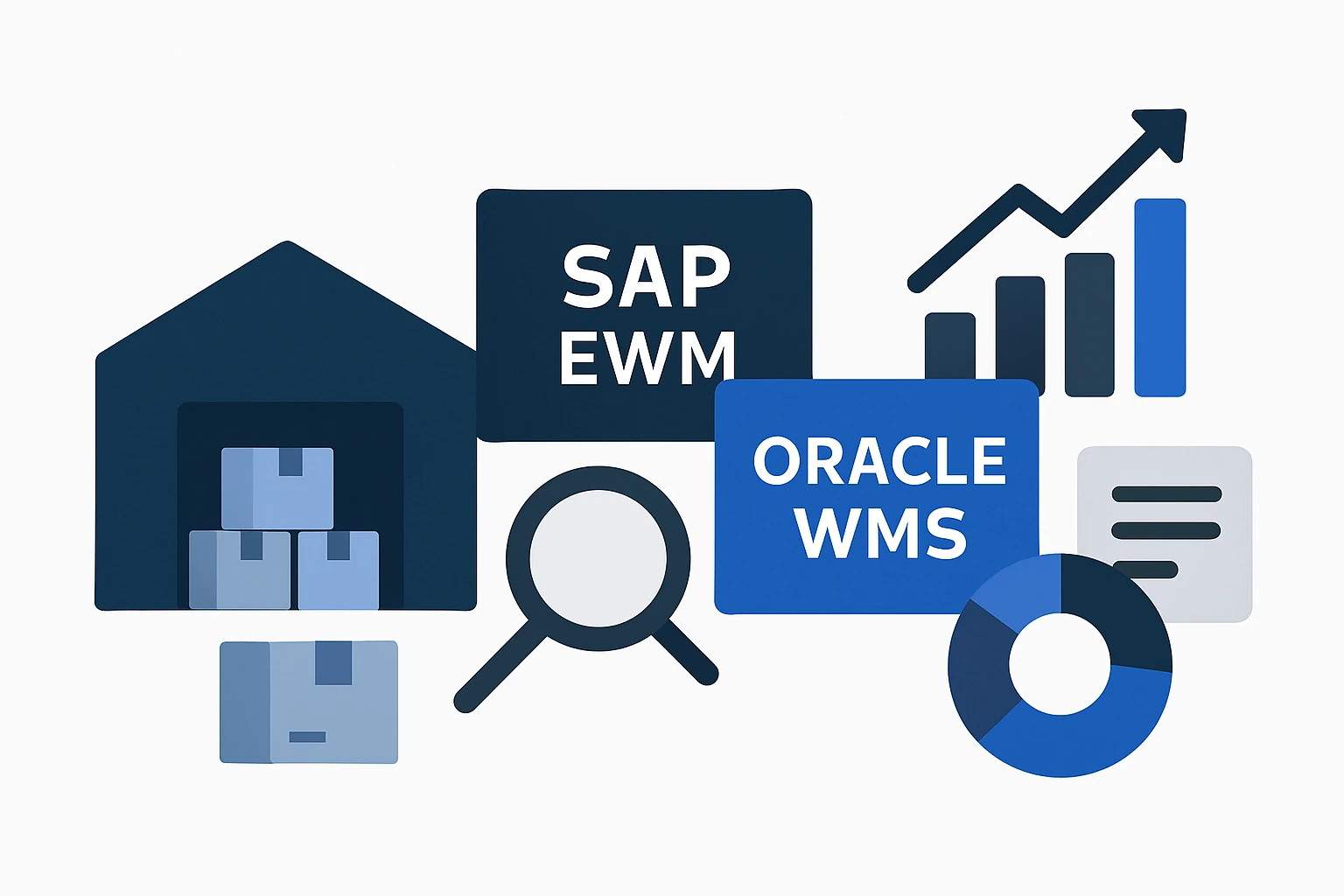
SAP EWM is a mature, deeply integrated WMS option that sits atop the SAP S/4HANA platform. It supports advanced processes such as slotting optimization, cross-docking, yard management, and detailed labor management, all within a single data model shared with other SAP modules. The architecture is particularly favorable for large, SAP-centric enterprises that want end-to-end process visibility and tight ERP integration. SAP EWM overview details the scope and dependencies of the module.
One expert insight: when you embed WMS logic in an SAP backbone, you unlock highly granular data coherence across orders, inventory, and finance, which can reduce reconciliation cycles and boost planning accuracy. This alignment, however, comes with a learning curve and a potentially longer implementation timeline compared with lighter-weight alternatives. (sap.com)
Oracle Warehouse Management Cloud
Oracle’s WMS Cloud emphasizes cloud-first deployment, rapid configuration, and multi-warehouse orchestration across a distributed network. It is designed to integrate with Oracle’s broader Cloud ERP and SCM portfolio, enabling quick time-to-value for mid-to-large scale networks seeking scalable, software-as-a-service coverage. Oracle Warehouse Management Cloud describes the cloud-native approach and cross-site capabilities. (oracle.com)
A practical note: Oracle’s WMS Cloud often appeals to organizations seeking a modern, service-led model with frequent updates and predictable operating expenses. However, adoption may require rethinking existing processes to leverage shared data services and cloud-native features effectively.
Section 3: The ROI conversation - building a practical ROI calculator for WMS decisions
ROI is the north star of any enterprise software decision. A disciplined ROI model estimates tangible benefits such as labor productivity gains, improved throughput, reduced error rates, and lower carrying costs, offset by software licensing, implementation, and change-management expenses. A simple framework for structuring a WMS ROI assessment might look like this:
- Baseline measurements: current throughput, cycle times, labor hours per order, and accuracy rates
- Target state: expected improvements from the new WMS in each metric
- Cost model: licensing or subscription, implementation, data migration, and ongoing support
- Benefits crystallization: labor savings, space utilization, inventory reductions, and service level improvements
- Timeline and risk: phasing, pilot results, and potential disruption during migration
Once these elements are defined, run a pilot or a staged rollout to validate the model with real data. The exercise is not purely mathematical, it requires realistic scenario planning and risk-adjusted assumptions. While many vendors provide ROI calculators as a planning aid, the value lies in the accuracy of the input data and the credibility of the projection. For example, industry benchmarks and vendor-agnostic frameworks can help anchor the ROI discussion.
Section 4: Data diligence and vendor data - how to validate sources in a crowded market
In vendor selection, the temptation to supplement due-diligence with broad internet data can be strong. Some teams encounter search results and datasets labeled as “download list of .cn domains,” “download list of .xyz domains,” or “download list of .top domains” as rough proxies for vendor origin or reach. These datasets are not substitutes for credible, verifiable references. A disciplined approach combines official product documentation, independent analyses (such as Gartner’s WMS evaluations), and customer references to create a robust evidence base. SAP EWM and Oracle WMS Cloud provide primary documentation to start the validation process. (sap.com)
Beyond vendor pages, independent market analyses remain valuable for cross-checking claims. For example, Gartner’s Magic Quadrant for Warehouse Management Systems offers a high-level view of vendor strengths and market dynamics, aiding a balanced evaluation. Gartner MQ for WMS summarizes the competitive landscape and is widely used by corporate teams during shortlisting. (gartner.com)
As you gather data, consider practical anchors such as a live pilot, customer references in a similar industry, and measurable KPIs tied to your actual throughput and service commitments. For teams conducting global research, opportunistic lists should be treated as starting points rather than final sources of truth. This is also an area where editorial, domain-specific publishers like WMS.info play a helpful role by curating independent comparisons and implementation experiences. For teams exploring external data sources, WebAtla’s CN-domain lists and related TLD directories can support background checks and governance workflows. See WebAtla CN domain lists and WebAtla TLD directory for reference.
Section 5: Limitations, trade-offs, and common mistakes in WMS selection
Even well-structured evaluations encounter blind spots. Common limitations include underestimating change management, assuming a single vendor will satisfy every process nuance, or over-relying on feature checklists without validating real-world impact. In practice, the most successful WMS deployments balance process reengineering with disciplined configuration, pilot testing, and gradual rollouts. A frequent misstep is choosing a “best-in-class” system for a static set of processes while the business evolves, organizations succeed by aligning the WMS with evolving fulfillment models, channel mix, and labor strategies.
A noteworthy trade-off is between deeply integrated ERP-driven WMS (like SAP EWM) and more agile cloud-native options (like Oracle WMS Cloud). The former can deliver stronger end-to-end data coherence but at heavier customization and longer deployment, the latter can enable faster value realization and easier upgrades, with a need for governance around data models and integration.
Section 6: A practical, vendor-agnostic framework you can apply today
Use this concise framework to guide your evaluation:
- 1) Define requirements clearly - map processes, data needs, and integration touchpoints across the network
- 2) Build a scoring rubric - weight capabilities such as inbound, outbound, localization, and reporting
- 3) Model ROI early - estimate benefits and costs with realistic inputs
- 4) Pilot with a controlled group - run a limited rollout before full-scale replacement
- 5) Plan a staged migration - align change management with IT governance and ERP integration
Framing the decision this way helps ensure you’re evaluating best WMS software choices through a lens of real business impact, not just feature density. For readers focused on domain-intensive research, consider pairing this framework with vendor-neutral sources and a trusted data-provider strategy to minimize bias.
Conclusion: a disciplined path to the right WMS choice
Choosing between SAP EWM and Oracle WMS requires a careful balance of process fit, technical architecture, and economic impact. The strongest decisions are grounded in a clearly defined requirement set, validated by a structured ROI model, and supported by credible references beyond vendor slickness. While SAP EWM offers deep ERP alignment and a set of advanced warehouse features, Oracle WMS Cloud provides cloud-native agility and scalable multi-site control. The best outcome often comes from a staged approach: pilot, measure, and scale - while keeping a rigorous data-didelity discipline that uses credible sources and, when useful, background data from trusted providers like WebAtla. For more information on global domain data resources, see the CN-domain list and the TLD directory linked earlier.