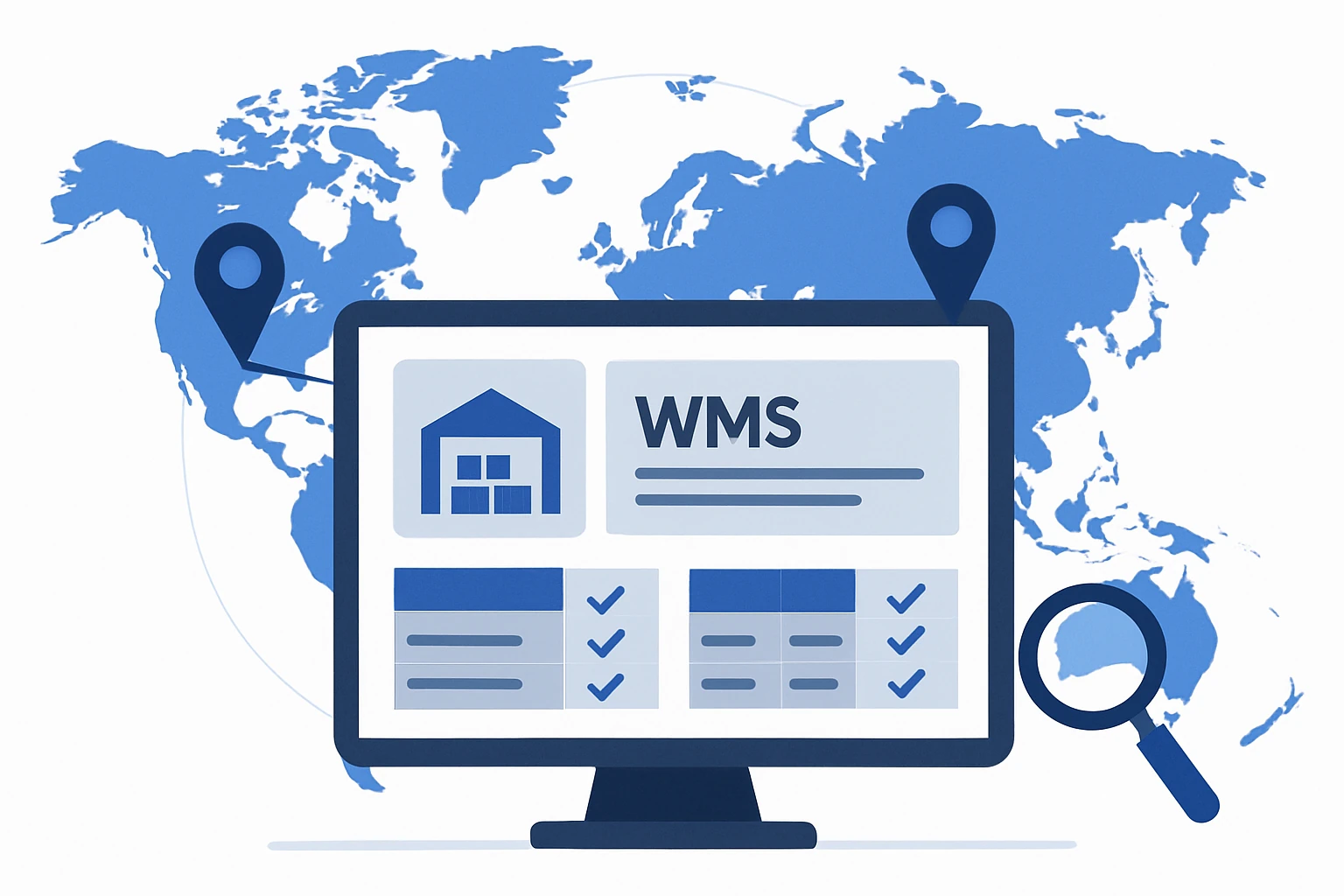

Choosing a warehouse management system (WMS) for a multi-site operation is not purely a technology decision. It is a program that touches warehouse operations, data governance, and the ability to scale across regions. The right WMS aligns with how warehouses operate, supports ERP integration, and delivers measurable ROI. Gartner's 2025 Magic Quadrant highlights a spectrum of established leaders and cloud-native challengers, underscoring the need for a rigorous, outcomes-focused evaluation. (gartner.com)
For large, multi-site operators, the landscape favors solutions that support scalability, real-time visibility, and seamless integration with ERP platforms. The 2025 Gartner MQ highlights leaders like Manhattan as a benchmark for large-scale WMS capabilities. (manh.com)
Key decision dimensions for WMS selection
Functional coverage and industry fit
Functional coverage matters most when the WMS must support complex warehousing with high-throughput, high-automation environments. SAP EWM, for example, is designed to handle advanced inbound/outbound processing and stock management within SAP S/4HANA, offering tight integration with broader supply chain modules. Learn more about SAP EWM. (sap.com)
ERP and automation integration
Consider how the WMS integrates with your ERP, transportation, and automation layers. SAP EWM’s integration with S/4HANA demonstrates one approach to unified processes across planning and execution, architectures can be embedded or decentralized depending on system strategy. EWM in S/4HANA deployment. (help.sap.com)
Deployment model and scalability
Deployment shape - cloud, on-premises, or hybrid - drives not only capex vs opex but also upgrade cadence and regional support. SAP EWM is offered in multiple deployment models and is actively updated to align with SAP S/4HANA roadmaps, illustrating how vendor strategies can affect long-term scalability. SAP EWM overview. (sap.com)
ROI and cost considerations
ROI and total cost of ownership (TCO) are central to a vendor comparison. ROI calculators and case studies are commonly used in the industry to illustrate potential payback, though results depend on baseline processes and the scope of deployment. ROI resources from vendor materials include tools and case studies. JASCI ROI calculator and OptiCrib ROI insights. (jascicloud.com)
Structured evaluation framework
The following framework distills how to compare WMS vendors in a way that translates to real-world outcomes, not just product brochures.
- 1. Define expected outcomes
Translate business goals into measurable warehouse KPIs (e.g., throughput per hour, inventory accuracy, shipment accuracy, dock-to-stock cycle time).
- 2. Map process requirements
Document required capabilities by area: inbound receiving, putaway, picking, packing, outbound, dock scheduling, and yard management.
- 3. Develop a scoring rubric
Use a weighted rubric across five dimensions: functionality (0–5), integration readiness (0–5), deployment model (0–3), usability and change management (0–2), and total cost of ownership (0–3).
- 4. Shortlist and run a PoV
Limit the shortlist to 3–4 vendors and run a proof-of-value (PoV) using representative workflows from your most critical processes.
- 5. Plan implementation with risk mitigation
Draft a phased deployment plan, including data migration, integration milestones, governance, and a change-management roadmap.
Expert insight
Expert insight: Industry analysts emphasize that successful WMS selection hinges on business outcomes and integration readiness, not just feature checklists. Gartner notes the importance of framing the decision around value realization and process fit. (gartner.com)
Limitations and common mistakes
- Overemphasizing feature breadth at the expense of process fit and data readiness.
- Underestimating the change-management effort required for a warehouse workforce and IT teams.
- Under-scoping data migration, master data governance, and integration with automation layers.
- Assuming one-size-fits-all deployment, overly complex pilots can delay value realization.
Practical implications for global WMS portals
As organizations expand across regions, the digital surface behind the WMS matters: vendor websites, regional support portals, and IT governance portals must remain consistent, secure, and easy to navigate. For teams that manage a global portal ecosystem, tools that govern domain strategies and digital assets can support the IT operations behind the WMS. See pricing and domain assets by TLDs as examples of how governance tools surface in multiregion IT programs.
Conclusion
Choosing a WMS for a multi-site operation requires a disciplined approach that ties technology decisions to operational outcomes and cost economics. A framework that starts with business goals, maps concrete process requirements, and applies a transparent scoring rubric helps organizations avoid common missteps and move faster from evaluation to value realization. When combined with strong governance for the broader IT surface that surrounds the WMS ecosystem, the payoff can be substantial across throughput, accuracy, and service levels.