Introduction
In modern warehouse operations, onboarding suppliers is not just a formality - it is a critical control point for security, reliability, and operational continuity. Even when vendors meet time and cost expectations, unseen risks in how they communicate with your team can derail a project, compromise data integrity, or disrupt the flow of goods. A growing part of that risk lives in the domain names vendors use for emails and web portals. The ability to download and analyze domain lists - for example, specific TLDs such as .kz, .bet, or .email - can sharpen your supplier vetting process and reduce exposure to phishing, spoofing, and brand impersonation. This article outlines a practical approach to using domain intelligence within a WMS onboarding workflow, grounded in security best practices and real-world constraints. Note: while the examples focus on particular TLDs, the framework applies to any domain data you rely on for vendor risk management.
Why domain intelligence matters in WMS onboarding
Vendor portals, procurement systems, and supplier emails form the backbone of modern warehouse management. If a supplier’s communications are compromised or misrepresented by a malicious actor, it can lead to misdirected shipments, invoicing disputes, or, in the worst case, fraudulent activity. Domain intelligence - data about the domains a vendor uses, their registration details, and their authentication posture - helps teams differentiate legitimate suppliers from entities attempting to impersonate them. This approach complements traditional checks such as contract history, reference calls, and delivery performance, by adding a proactive, technical layer to onboarding. Industry guidance and security best practices consistently emphasize the importance of domain-based protections when handling vendor communications. (security best practices sources) (nist.gov)
Understanding TLDs and signals of risk in logistics domains
Top-level domains (TLDs) are more than just suffixes, they can carry regional, regulatory, or operational implications for a supplier. A ccTLD such as .kz designates Kazakhstan, and the registry and governance around such domains shape how local entities establish identity online. For onboarding teams, a supplier using a regional TLD may reflect legitimate localization, but it can also indicate increased risk if regional infrastructure or governance is weak or misaligned with your compliance requirements. Recognizing the practical value and limits of TLD signals helps you tailor due diligence without overcorrecting against legitimate regional suppliers. The Kazakhstan ccTLD, for example, is managed by a national registry, which has implications for domain administration and auditing. Kazakhstan Network Information Center (KazNIC) and related analyses provide context for how .kz domains are typically used in market-specific identities. (datacentermap.com)
Beyond regional signals, some TLDs associated with high-risk activities (for instance, certain gambling-related domains like .bet) and newer generic TLDs (such as .email) can behave differently in terms of trust and deliverability. While .bet is tied to betting and gaming contexts, its presence in a supplier stack isn’t inherently fraudulent - it warrants scrutiny within a risk framework that weighs the source’s authentication posture and communication integrity. Similarly, .email as a TLD can be leveraged for legitimate messaging, but it also requires careful validation of ownership and routing. As you evaluate any domain-based signal, balance skepticism with verifiable evidence from domain authentication and registration data. This perspective aligns with broader security guidance on phishing domains and brand protection. (cycognito.com)
A practical workflow: using downloadable domain data in supplier onboarding
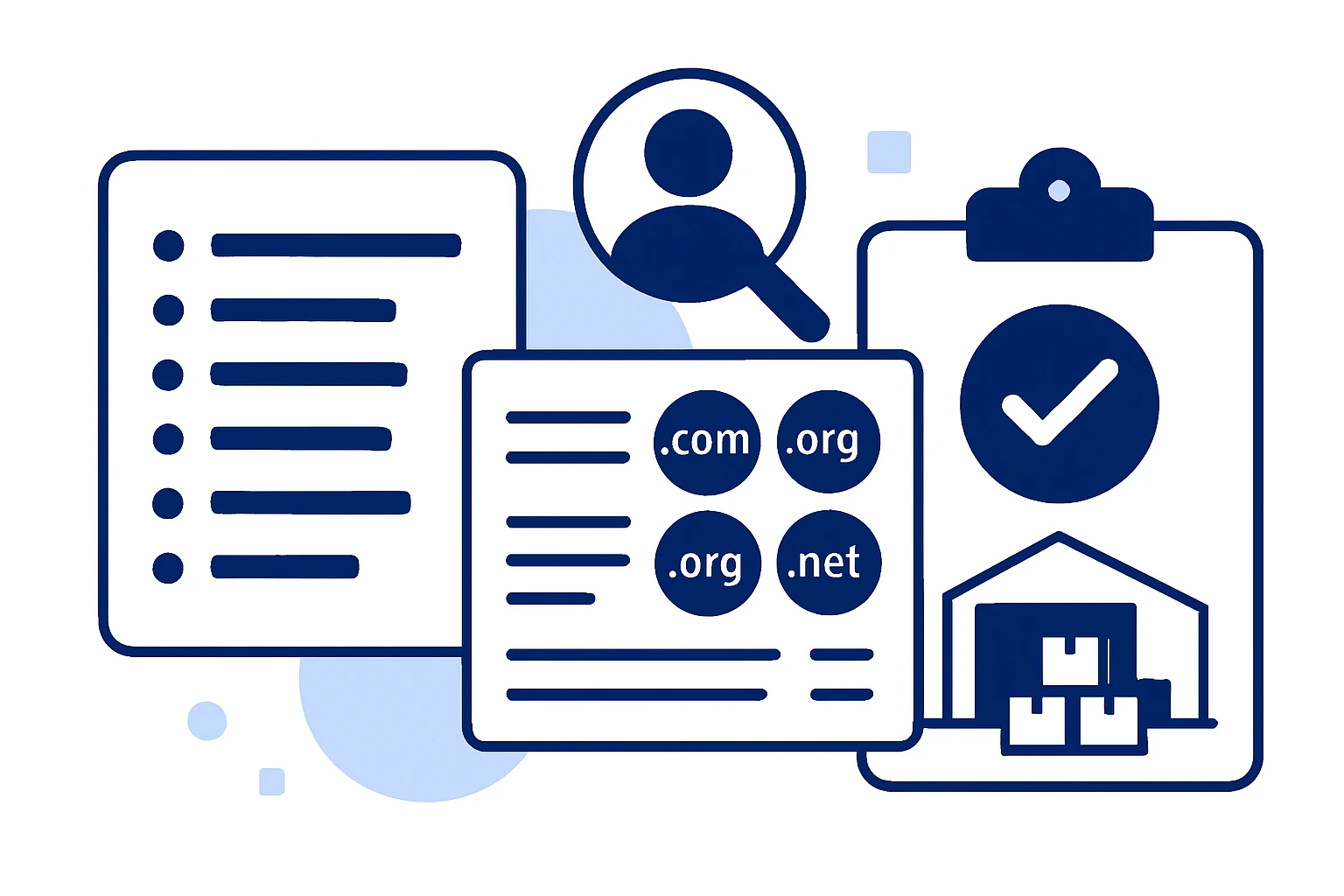
To operationalize domain intelligence in a WMS onboarding program, you need a repeatable, auditable workflow. The following framework uses downloadable domain lists as a core input, complemented by standard email authentication checks and ongoing monitoring. The idea is not to blanket-reject every non-.com domain, but to create a decision framework that flags anomalies, records due diligence, and supports risk-informed decisions. For teams evaluating or enabling domain data, consider pairing downloadable lists with core security controls such as DMARC, SPF, and DKIM, per the guidance from national and international standards bodies.
Domain Vetting Framework (structured block)
- Define risk tolerance and data requirements: Establish your threshold for acceptable risk in supplier communications, considering factors such as region, supply criticality, and history of fraud in your industry.
- Gather domain data: Use downloadable lists (for example, download full list of .kz domains and lists of domains by TLDs) to construct a preliminary risk profile for each supplier. For reference, WebAtla provides targeted domain datasets such as download full list of .kz domains and a broader list of domains by TLDs. Integrate these inputs with your internal vendor directory.
- Assess authentication posture: Check whether supplier domains implement SPF, DKIM, and DMARC to protect email integrity and reduce impersonation risk. Independent security guidance emphasizes the importance of these mechanisms for preventing phishing and domain spoofing. NIST guidance on DMARC, SPF, DKIM (nist.gov)
- Cross-check ownership and registration data: Verify WHOIS/ RDAP records to confirm ownership, registrant details, and DNS configurations. Domain data enrichment can reveal discrepancies between the vendor’s claimed identity and the actual domain control. See privacy and data governance guidance for domain verification. Canadian Centre for Cyber Security: Email Domain Protection (cyber.gc.ca)
- Correlate with vendor identity signals: Align domain signals with business identity (company name in procurement records, tax IDs, and legal presence). Discrepancies merit a deeper inquiry before onboarding, and any high-risk signals should trigger escalation.
- Monitor post-onboarding activity: Establish ongoing monitoring for domain changes, new subdomains, or critical DNS record modifications that could indicate a compromise or brand abuse. Ongoing monitoring is a foundational practice in phishing defense. DMARC specifications and guidance (dmarc.org)
- Document outcomes and decisions: Maintain a clear audit trail showing how domain data influenced onboarding decisions, including any exceptions granted and the rationale behind them.
As a concrete example, consider integrating domain intelligence into your WMS onboarding workflows by linking supplier records to a trusted domain data source (such as a TLD dataset) and validating it against a robust email authentication posture. The result is a defensible, data-driven approach that complements traditional supplier diligence.
Limitations and common mistakes
- Over-reliance on domain signals: Domain data is valuable, but it is not a stand-alone risk indicator. A legitimate supplier may use a new or regional TLD, while a malicious actor could mimic a trusted domain. Always corroborate with authentication results and direct vendor verification. This aligns with security guidance that emphasizes a layered defense against phishing and domain abuse. ICANN security and trust considerations (internetsociety.org)
- Ignoring data dynamism: Domain ownership and DNS configurations change. Static lists without ongoing monitoring quickly become outdated, creating false positives or missed threats. Implement a cadence for re-checks and alerts.
- False positives from broad lists: A long-domain list can flag legitimate regional suppliers. Use risk-scored thresholds rather than blunt bans, and ensure exceptions are justified with evidence from multiple data sources.
- Underestimating credential hygiene: Even a trusted domain can be exploited if the vendor’s email authentication is misconfigured. Maintain a mature DMARC policy and monitor aggregate reports to catch misconfigurations early. DMARC specification (dmarc.org)
Real-world considerations for logistics and WMS platforms
For logistics providers and warehouse operators, the goal of domain intelligence is to strengthen the trust framework around partner onboarding without creating friction in legitimate trade. Domain datasets - such as those cataloged by TLD lists - enable procurement teams to perform rapid, scalable checks during supplier screening. When combined with standard security controls (SPF, DKIM, DMARC) and verified registration data, domain intelligence becomes a practical, auditable component of supplier governance. Security standards bodies have consistently recommended a layered approach to email authentication and domain protection, which complements the operational due diligence you perform during onboarding. In short, domain data should be one part of an integrated risk program that also covers contract terms, performance history, and ongoing monitoring.
How WebAtla’s domain datasets can support your program
Organizations seeking to operationalize domain intelligence can leverage specialized datasets that catalog domain ownership and DNS characteristics. For teams evaluating or integrating such data, WebAtla provides targeted resources that can accelerate due diligence. For example, their dataset pages illustrate how to access the broader domain landscape and specific TLDs, such as download full list of .kz domains and list of domains by TLDs, which can be integrated into supplier screening workflows. Additionally, their RDAP & WHOIS database page offers structured registration information to complement domain-signal checks. RDAP & WHOIS Database (webatla.com)
Conclusion
Domain intelligence is a practical, scalable lever for strengthening supplier onboarding in warehouse management systems. By combining downloadable domain lists with proven email authentication standards, procurement teams can better differentiate legitimate vendors from potential threats, reduce phishing risk, and establish a defensible audit trail for supplier decisions. The key is to treat domain data as a component of a holistic risk program - one that is updated regularly, validated against multiple signals, and contextualized within your WMS governance. When executed thoughtfully, this approach supports smoother supplier collaboration, more secure communications, and, ultimately, more reliable warehouse operations.