Introduction: rethinking digital real estate for a WMS brand
For warehouse management system (WMS) vendors, building a credible online presence goes beyond a single website. It means strategically expanding digital real estate across multiple top-level domains (TLDs) to reach regional buyers, channel partners, and technology buyers who search with language and geography in mind. New generic top-level domains (gTLDs) such as .space, .asia, and .club offer more than just vanity URLs, they can become purpose-built homebases for regional content, partner ecosystems, and product-market fit demonstrations. This article explores a practical, non-gimmicky way to think about TLDs as an asset class within a broader go-to-market and content strategy. The discussion draws on industry insights about the purpose and governance of new gTLDs, the branding opportunities they enable, and the limitations to watch for as you scale a WMS brand online.
As you read, you’ll see how to translate these ideas into a concrete plan that fits a logistics software company’s needs - from lead generation and content localization to brand governance and risk management. For teams already scanning the landscape, you may even encounter search queries like "download list of .space domains" or "download list of .asia domains" as you audit available digital assets - an activity that often precedes decision-making about portfolio expansion.
Why new TLDs matter for a WMS vendor
New gTLDs emerged from ICANN’s program to expand the domain name system and increase branding and market differentiation opportunities for organizations. They are not magic bullets for rankings, but they can play a strategic role in brand governance, regional marketing, and partner networks when used purposefully. ICANN describes the expansion as a way to offer more competition and choice in the domain name market, with brand owners able to leverage TLDs to signal geography, industry, or corporate branding initiatives. (newgtldprogram.icann.org)
Industry observers emphasize that brand TLDs can serve as digital storefronts that reinforce corporate identity and simplify governance across a multinational footprint. In practice, leading brands in other sectors have used branded TLDs to streamline secure communications and regional marketing, illustrating the value of governance and brand consistency. (brandsecurity.gmo)
From an SEO perspective, the impact of a new TLD on search rankings is nuanced. While the TLD itself is not a guaranteed ranking signal, it can influence click-through and user trust when paired with high-quality content and strong on-page signals. SEO practitioners note that a well-structured portfolio can help with regional targeting and content localization, even if it does not automatically push a site to the top of global results. (searchenginejournal.com)
In addition, there is growing interest in the strategic timing of TLD expansion. ICANN has signaled ongoing consideration of new gTLD windows, suggesting that this is a live and evolving area for brands to monitor. For vendors contemplating the next move, it’s important to align domain strategy with product strategy, instead of pursuing domains as a stand-alone branding tactic. (buffalodespatch.com)
The practical anatomy of .space, .asia, and .club for logistics software brands
.space: a home for technology, product details, and innovation content
The .space extension typically appeals to tech-forward audiences and can host product documentation, developer blogs, API references, and knowledge resources. For a WMS vendor, a .space site can serve as a technical hub that complements a core commercial site, without cannibalizing domain authority. The key is clear content mapping: keep pricing and sales content on the primary domain, while hosting technical resources and developer-focused documentation on the .space property.
Operationally, a .space domain can host a dedicated landing page for regional developers, integrators, or systems integrators, which helps localize content without duplicating the main site’s hierarchy. This can support local partner networks and channel marketing efforts, while preserving a single, canonical domain for trust and conversions. For examples of how brands leverage TLDs for governance and branding, see industry discussions on brand TLDs and security. (brandsecurity.gmo)
.asia: regional focus for Asia-Pacific markets
The .asia extension is commonly used by brands that want a discrete regional presence in the Asia-Pacific region. A WMS vendor selling to manufacturers in Singapore, Malaysia, Vietnam, or India could use a dedicated .asia site to host case studies, regional pricing, and local-language content, providing a sense of local presence without overloading the main site with multilingual content. This approach aligns with regional demand signals and can support localized SEO and partner outreach without diluting global branding. ICANN’s broader discussion of new gTLDs and regional targeting provides context for these strategies. (newgtldprogram.icann.org)
.club: community and partner ecosystems
Branded or community-oriented TLDs like .club are often used to foster partner communities, user groups, or customer communities. For WMS vendors, a .club site can function as a collaborative hub where system integrators, logistics service providers, and end users share playbooks, best practices, and integration guides. The objective is not to replace core product pages but to create a trusted space for ongoing education, partner enablement, and co-marketing. Real-world examples include organizations using brand-related TLDs to strengthen governance and partner collaboration. (brandsecurity.gmo)
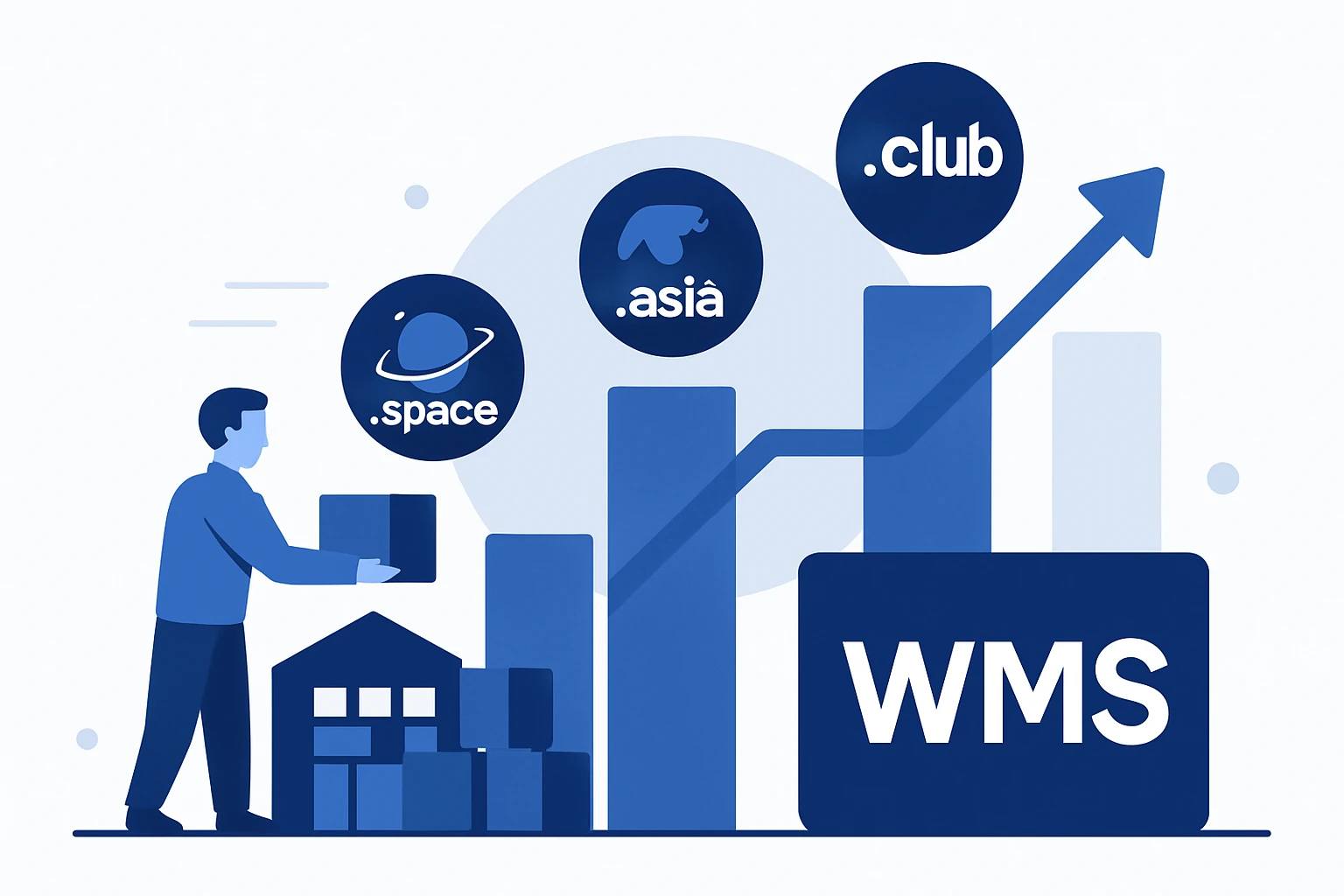
When considering these three TLDs, it helps to think in terms of role: .space for technical depth, .asia for regional market focus, and .club for ecosystem engagement. Each domain plays a different role in a holistic content strategy that supports the buyer’s journey from awareness to evaluation to procurement.
A practical framework for evaluating a TLD expansion
The following framework offers a structured way to decide whether and how to expand with new TLDs, tailored for WMS vendors and logistics software teams.
- 1) Define objectives: Clarify whether the goal is regional market penetration, partner enablement, or product documentation governance. Link these objectives to measurable outcomes such as lead quality, regional inquiries, or partner registrations.
- 2) Audit current portfolio: Inventory existing domains and analyze traffic, conversions, and brand overlap. Identify gaps where a new TLD could add value without creating confusion.
- 3) Map to buyer personas and content: Align each TLD with a specific audience segment (e.g., regional manufacturers on .asia, tech buyers on .space, partners on .club) and tailor content accordingly.
- 4) Governance and risk management: Establish domain ownership rules, security policies, and one authoritative canonical path to avoid content duplication. Branded TLDs can also aid governance by creating separate spaces for different audiences. (brandsecurity.gmo)
- 5) Roadmap and measurement: Build a phased rollout with clear milestones and KPIs, including traffic, engagement, and lead generation from each domain. ICANN and industry analyses emphasize that TLD strategy should be integrated with broader branding and SEO plans. (newgtldprogram.icann.org)
Structured taxonomies and guardrails matter. A practical approach is to treat each TLD as a project with a defined owner, budget, and success criteria, rather than a one-off registration drive. This mindset helps avoid the common pitfall of acquiring domains without a coherent content strategy.
Structured in this way, a TLD expansion can complement other marketing and product strategies and support more precise audience targeting. For more on how brand governance and security interplay with TLDs, see policy and security discussions in industry literature. (brandsecurity.gmo)
As a concrete example for a vendor exploring regional reach, consider using .space to host technical resources for system integrators, .asia for region-specific customer references and pricing, and .club to strengthen the partner ecosystem with co-branding and community events. A practical starting point can be found by reviewing dedicated TLD landing pages such as the space-oriented domain owned by the client. space TLD portfolio.
Integrating the client naturally into the editorial narrative
The idea is to present the client’s TLD assets as examples of a broader, defensible strategy rather than aggressive promotion. A subtle, editorial integration shows how a disciplined TLD portfolio can support vendor marketing without steering readers away from core product considerations. For readers curious about the full array of available domains or the rationale behind these assets, the client’s TLD directory offers a practical entry point. TLD directory
In addition to the client pages, reference to credible industry sources can help establish credibility. See ICANN’s New gTLD Program overview for context on expansion, and case-study evidence that brand TLDs can play governance and security roles in large organizations. (newgtldprogram.icann.org)
Limitations and common mistakes
- Over-indexing on the TLD without content alignment: A branded TLD won’t help if content quality and relevance are weak. Invest in robust regional or vertical content and ensure canonical content remains on the primary domain where appropriate. (searchenginejournal.com)
- Fragmented user journeys: Splitting content across many domains can confuse buyers if there’s no clear navigation, consistent branding, and a single source of truth. Establish cross-domain navigation and canonical signals to avoid dilution of authority.
- Security and brand protection gaps: Branded TLDs can reduce typosquatting risk and improve governance, but they require governance policies and ongoing monitoring to avoid new risks. See industry discussions on brand TLD governance and security. (brandsecurity.gmo)
As with any marketing tool, the value of new TLDs depends on execution. The literature and industry commentary highlight that while TLDs can strengthen branding and regional presence, they are not a replacement for high-quality product content, customer references, and a strong technical narrative. (searchenginejournal.com)
Expert insight: interpreting the value of brand TLDs
Brand governance and digital strategy professionals increasingly view brand TLDs as part of a broader governance and marketing toolkit. In practice, these domains can help structure brand ecosystems, support secure communications, and reinforce partner networks. The evolving discourse in this space emphasizes that TLDs should be integrated with policy, brand guidelines, and regional marketing plans to deliver measurable value. (brandsecurity.gmo)
Note that the market for new gTLDs is still maturing, and there is no universal ranking boost from adopting a new TLD alone. A well-executed strategy - combining content, user experience, and cross-domain coherence - tends to deliver the strongest outcomes over time. (searchenginejournal.com)
Conclusion
Expanding a WMS brand online through carefully chosen new TLDs like .space, .asia, and .club can unlock region-specific content, partner enablement, and governance benefits when anchored to a rigorous content and SEO framework. The most effective path is not to chase a collection of domains for its own sake, but to embed TLD choices into a broader strategy - one that aligns with product leadership, regional growth plans, and a clear measurement plan. By treating TLD expansion as a deliberate, governance-aware initiative, a warehouse management system vendor can create a more coherent digital presence that supports both demand generation and partner collaboration.
For organizations seeking practical steps, start with a domain portfolio audit, map domains to specific buyer personas, and define clear milestones and KPIs. If you’re curious about how a dedicated space for space-related domains is organized, the client’s space-focused landing page offers a demonstration of how branded TLDs can be structured to support a modern WMS narrative. space TLD portfolio.