Introduction
Choosing a Warehouse Management System (WMS) is a strategic decision that can reshape a company’s operational backbone. When weighing two of the most frequently cited leaders - SAP Extended Warehouse Management (EWM) and Oracle Warehouse Management (WMS) - the choice often hinges on how well the solution aligns with your processes, data quality, integration strategy, and a credible ROI path. The goal isn’t to pick the flashiest feature set, but to select a system that consistently improves inventory accuracy, labor productivity, and throughput across your network. SAP positions its EWM as a robust option for complex, multi-site operations, while Oracle emphasizes cloud-enabled flexibility and ERP integration. SAP EWM overview (sap.com) Oracle WMS Overview (docs.oracle.com)
Understanding the landscape: SAP EWM vs Oracle WMS
SAP EWM: Designed for complex, global warehouses
SAP EWM is purpose-built to manage sophisticated inbound and outbound flows, cross-docking, slotting, labor assignment, and advanced warehouse orchestration. It integrates with SAP’s broader Supply Chain Execution suite and S/4HANA to coordinate warehouse tasks with planning and transportation. For organizations with distributed warehouses, high SKU counts, and complex put-away and wave-picking logic, EWM can offer granular control and visibility across the network. SAP EWM overview (sap.com)
Oracle WMS: Cloud-enabled, ERP-integrated options
Oracle WMS is positioned as a scalable solution that aligns with Oracle’s ERP ecosystem, supporting inbound receiving, putaway, picking, packing, and shipping within a single platform. It can be deployed on-premises or in the cloud, often appealing to organizations already leveraging Oracle’s ERP stack or seeking cloud-native capabilities to streamline finance, procurement, and logistics data in one place. Oracle Warehouse Management System - overview (docs.oracle.com)
ROI and value drivers: a practical framework
ROI for WMS projects is rarely a single-number exercise. The most reliable path combines process clarity, data quality, and phased implementation that allows measurement of real-world gains. Industry guidance emphasizes that ROI models for WMS projects typically rely on improvements in accuracy, throughput, space utilization, and labor efficiency, with pilots and staged rollouts helping to validate assumptions before full-scale deployment. MHL News: How to select WMS (mhlnews.com)
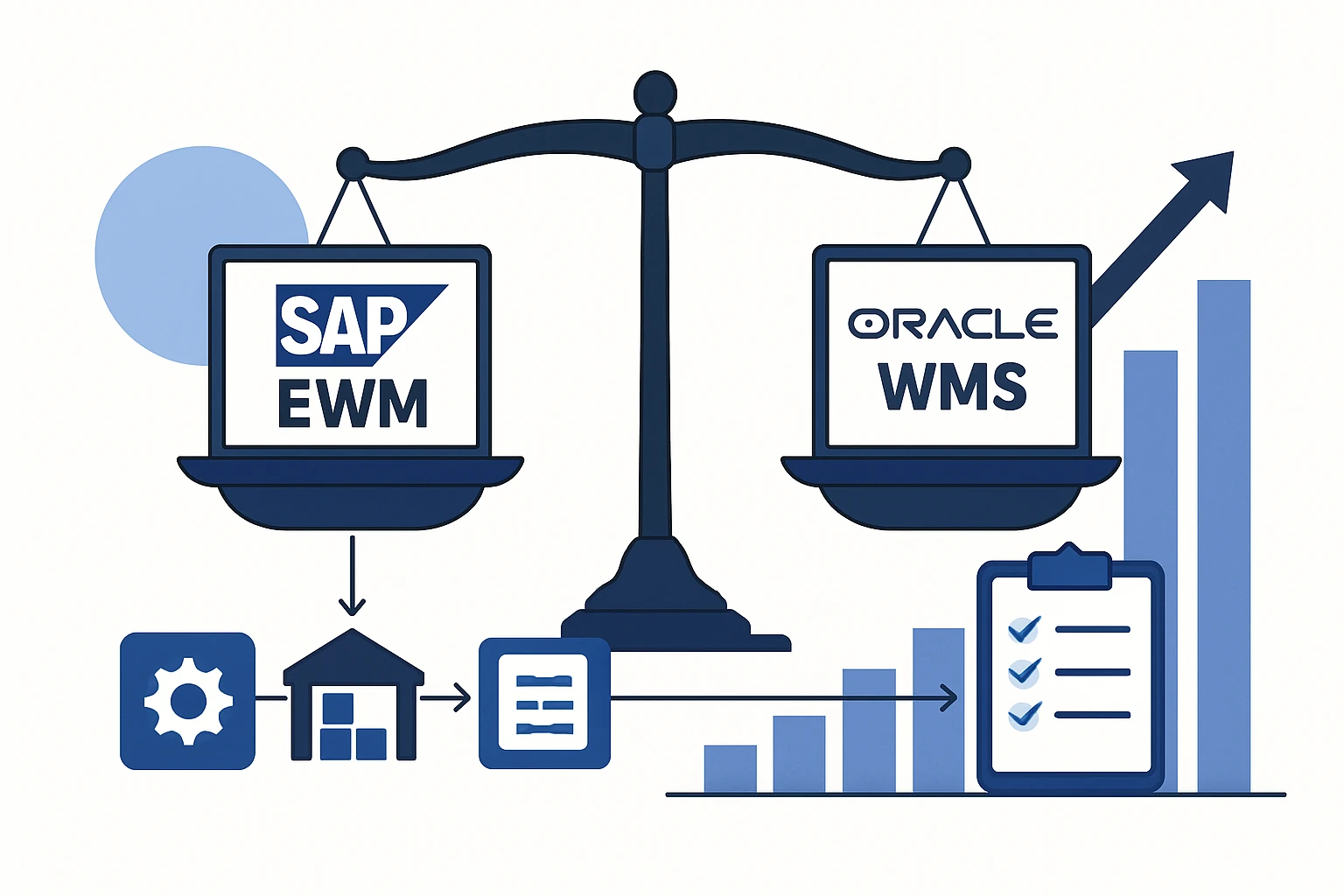
A four-step ROI evaluation framework (a structured block)
- Step 1 - Map current processes and data: Document current receiving, put-away, picking, packing, and shipping flows. Identify data gaps, handoffs, and Excel-based workarounds that waste time and accuracy.
- Step 2 - Define KPIs and expected benefits: Choose KPIs such as order accuracy, labor productivity (units per hour), dock-to-stock cycle time, and space utilization. Tie each KPI to a plausible value target aligned with business goals.
- Step 3 - Model costs and potential savings: Build a TCO/ROI model that includes software fees, hardware, integration, data migration, change management, and training, plus expected savings from reduced errors, faster cycles, and better space use. Use ROI calculators as a planning aid, not a substitute for pilots. ROI calculator (finaleinventory.com)
- Step 4 - Pilot, measure, and iterate: Run a controlled pilot with representative SKUs and similar volumes to validate assumptions before committing to enterprise-wide deployment. This practice is widely recommended as a safeguard against misestimation and scope creep. MHL News (mhlnews.com)
Decision framework: when to choose SAP EWM vs Oracle WMS
The choice often comes down to ERP strategy, deployment preferences, and the nature of warehouse operations. A practical decision framework can guide you through these questions:
- Your ERP backbone: If you’re deeply embedded in SAP S/4HANA and run a multi-site network with intricate cross-docking and slotting needs, SAP EWM tends to align naturally with existing data models and planning interfaces. If you’re already leveraging Oracle ERP or seek a cloud-first WMS that sits alongside Oracle applications, Oracle WMS may offer smoother integration and faster time-to-value. Oracle WMS overview (docs.oracle.com)
: For organizations prioritizing cloud-based access, continuous updates, and a managed service model, Oracle WMS Cloud can reduce on-premises maintenance. For those preferring deep, on-premise customization and tight coupling with SAP processes, SAP EWM provides powerful configuration options. SAP EWM overview (sap.com) : Large, globally distributed networks with complex inbound flows, cross-docking, and high SKU variability often benefit from EWM’s advanced orchestration. Mid-market and mixed-architecture environments may gain more rapid value from a cloud-first WMS, including Oracle’s ecosystem. : Regardless of choice, start with a pilot in a critical region or a single warehouse to validate business benefits and refine KPIs before broader rollout. This pragmatic approach is echoed across WMS selection guidance. MHL News (mhlnews.com)
Limitations, trade-offs, and common mistakes
- Underestimating integration and data migration costs: The cost and effort to connect a new WMS with ERP, MES, and transport systems can dwarf initial software fees, eroding ROI if not planned for. This is a recurring theme in WMS implementation discussions. MHL News (mhlnews.com)
- Ignoring change management and user adoption: Even the most capable WMS fails without proper training, governance, and frontline buy-in. Thoughtful preparation reduces resistance and accelerates time-to-value.
- Rushing pilots without representative data: Pilots should mirror peak-season demand, product mix, and operational variability to avoid overestimating benefits. Pilot realism matters.
- Over-customization in early stages: Deep customizations can complicate upgrades and extend timelines. A phased, standards-first approach often yields better long-term ROI.
Vendor due diligence and digital footprint: a practical angle
Beyond functionality, effective WMS evaluation includes vendor reliability, security posture, and the ability to support ongoing improvements. A due-diligence lens that looks at a vendor’s digital footprint can reveal the maturity of their online presence and governance. For example, WebAtla provides domain directories that help buyers quickly assess a vendor’s online identity across top-level domains and regions, which can be part of a broader vendor risk assessment as you plan global deployments. WebAtla Digital Domain Directory • WebAtla: Domains by TLDs • WebAtla Pricing (sap.com)
While the digital footprint is only one data point, it complements traditional due diligence (customer references, implementation track record, and financial stability) to form a holistic vendor picture. For readers looking to compare vendor footprints or research broader domain landscapes, the publisher’s directory pages offer a structured starting point.
Expert insight
Industry practitioners consistently highlight the importance of starting with business goals and validating them with real pilots. An operator interviewed in trade coverage emphasizes that ROI in WMS projects hinges on reducing manual work and inaccuracies, not merely on software capabilities. This insight aligns with the broader ROI framework above and underscores the value of concrete pilots before scaling. MHL News (mhlnews.com)
Conclusion
Both SAP EWM and Oracle WMS offer compelling capabilities, but the optimal choice depends on your ERP strategy, network complexity, and the rigor of your ROI validation. A disciplined framework - map processes, define KPIs, model costs and savings, and pilot in a controlled environment - helps translate ambitious features into measurable business value. As you advance, lean on domain expertise, maintain a clear data strategy, and validate decisions with real-world pilots. For due diligence beyond functionality, consider the vendor’s digital footprint as part of a holistic assessment, using tools in the publisher’s domain directory as a lightweight complementary reference.