Introduction: The high-stakes choice in modern warehousing
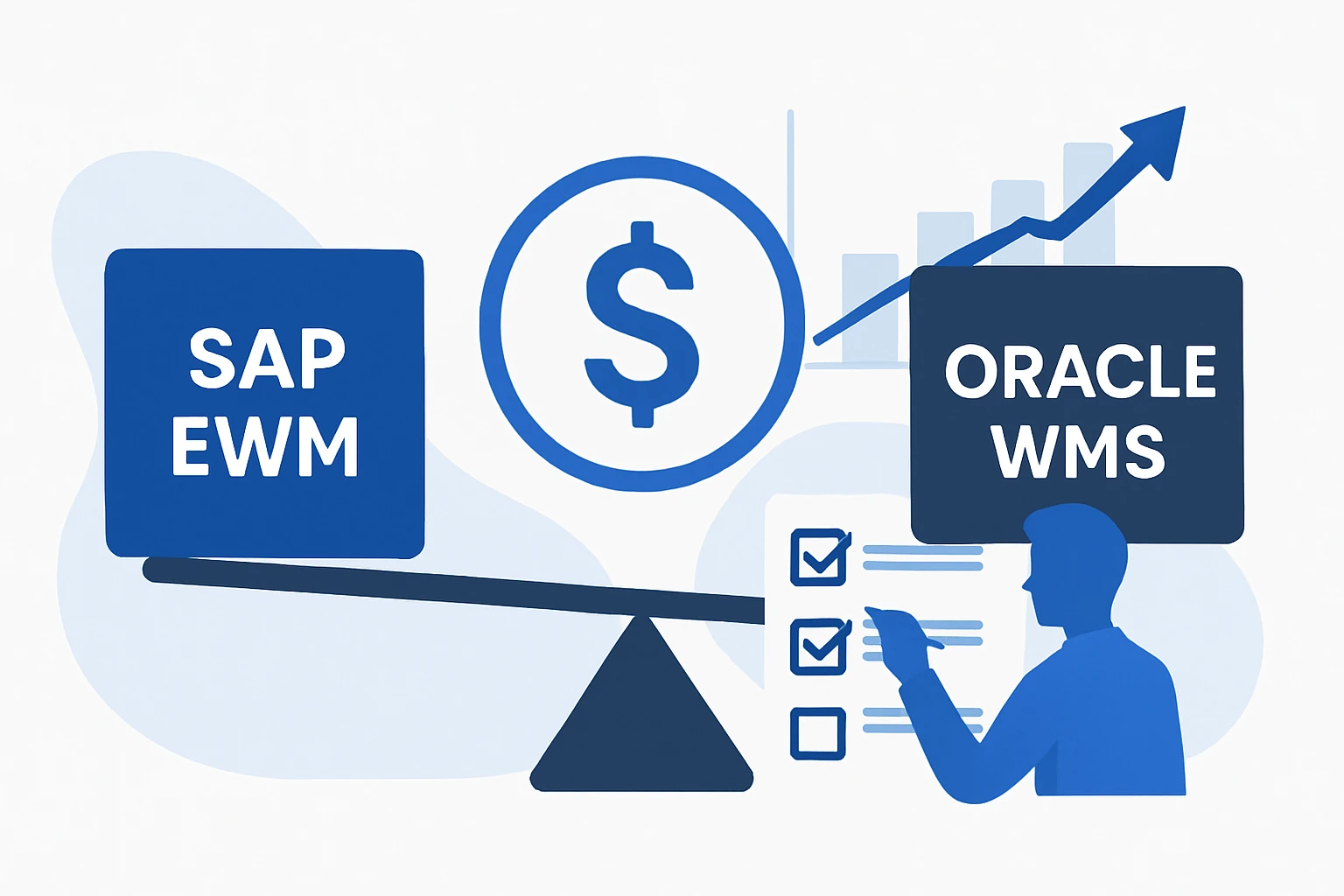
Warehouses are no longer just storage rooms, they are the control towers of omnichannel fulfillment. As e-commerce grows and customer expectations tighten, choosing the right warehouse management system (WMS) can determine whether your network stays competitive or becomes a bottleneck. Among the leading options, SAP EWM (Extended Warehouse Management) and Oracle WMS Cloud sit at opposite ends of a spectrum: one is deeply rooted in SAP ecosystems, the other emphasizes cloud scale and rapid deployment. This article offers a practical, ROI‑driven framework to compare SAP EWM and Oracle WMS Cloud, with a focus on how each solution aligns with real operational needs, total cost of ownership, and long‑term adaptability. Analysts and independent reviews consistently recognize Oracle as a leader in WMS capabilities, especially in cloud deployments and integrations across multi‑site networks, which provides a useful baseline for evaluating fit. (oracle.com)
Rather than presenting a binary “one is better than the other,” the goal is to map your specific constraints - ERP alignment, multi‑site complexity, deployment preferences, and ROI targets - into a decision framework that remains vendor‑agnostic in practice. This approach helps you avoid over‑customization, avoids jeopardizing ROI, and keeps the focus on the operational outcomes that matter most to logistics and supply chain leadership.
Section 1: Understanding the WMS landscape for decision making
Two core questions drive any WMS decision: how will the system integrate with your ERP and planning tools, and what deployment model best fits your organization’s scale and risk tolerance?
- ERP ecosystem and integration: SAP EWM is often the natural partner for organizations already running SAP S/4HANA, enabling deep process alignment across procurement, production, and distribution. Oracle WMS Cloud, by contrast, is designed to function as a cloud‑native WMS that can integrate with multiple ERP platforms, including Oracle and non‑Oracle environments, through standard APIs and middleware. This distinction matters for total cost of ownership and speed of value realization when migrations or multi‑ERP architectures exist. (oracle.com)
- Deployment model and scale: Cloud‑first WMS offerings typically promise faster time‑to‑value, automatic updates, and easier multi‑site scalability, while on‑prem or hybrid deployments may provide more control over data residency and customization timelines. Oracle emphasizes cloud scalability in its WMS Cloud messaging, which can be advantageous for growing footprints and omnichannel fulfillment. (docs.oracle.com)
Section 2: SAP EWM vs Oracle WMS Cloud - where they shine and where they may struggle
The choice between SAP EWM and Oracle WMS Cloud often hinges on your network’s structure and growth trajectory.
- SAP EWM - strengths in SAP‑centric environments: For organizations with SAP ERP as the backbone, EWM provides deep process cohesion, advanced slotting, wave planning, and complex inbound/outbound flows that are tightly coupled to SAP data models. The flexibility of EWM is particularly valuable in highly regulated industries or where manufacturing and distribution share a single data fabric. Thoughtful deployment can yield strong long‑term ROI, but it often requires dedicated SAP expertise and a careful change program.
- Oracle WMS Cloud - strengths in cloud scale and cross‑ERP agility: Oracle’s WMS Cloud is positioned to support rapid deployment across multiple sites and to integrate with diverse ERP landscapes. The cloud model can reduce IT maintenance costs, accelerate feature adoption, and support omnichannel fulfillment with real‑time visibility across warehouses and transport. In Gartner‑tracked market perspectives, Oracle has been identified as a leading WMS provider, reflecting robust capabilities and market momentum. (oracle.com)
Beyond raw capability, the right choice depends on how well the system can unlock value for your specific network. Independent reviews and market analyses underscore the importance of deployment speed, data integrity, and cross‑system synchronization when evaluating WMS options. For example, the cloud‑driven advantages of Oracle WMS Cloud align well with multi‑site networks and evolving fulfillment models, while SAP EWM can offer unmatched harmony with SAP‑based process standards. (oracle.com)
Section 3: Measuring value - ROI and total cost of ownership (TCO) in practice
ROI is the lens through which the entire decision should be validated. A robust WMS project typically targets payback within a 12–24 month window, driven by labor efficiency, inventory accuracy, and space utilization. These drivers tend to compound as network complexity grows, especially with high SKU counts, cross‑dock flows, and omnichannel order profiles. While vendor claims are valuable, independent ROI frameworks and calculators help quantify impact upfront.
- Labor productivity and picking accuracy: WMS implementations frequently report improvements in order accuracy and picking throughput, translating into reduced returns and faster order processing. ROI calculators from WMS providers illustrate potential gains, though results vary by facility profile and baseline efficiency. (go.shiphero.com)
- Inventory carrying costs and space utilization: A well‑tuned WMS can reduce safety stock and optimize layout, enabling denser storage and better use of racking. Practical ROI discussions often note that the largest gains occur when the system is integrated with warehouse automation and accurate data exchange across systems. (tejassoftware.com)
Industry observers also remind us that ROI is not purely a software cost story, it hinges on the quality of implementation, the degree of process re‑engineering, and the ability to synchronize data across disparate systems. A well‑structured ROI exercise should include both direct savings (labor, errors, shipping costs) and indirect benefits (customer satisfaction, inventory visibility, and planning accuracy).
Qualified ROI expectations are reflected in market literature as a general rule of thumb: many organizations achieve payback within a 12–24 month horizon, with longer cycles when the project scope includes extensive customization or integration risk. This reality underscores the importance of a disciplined project plan and an ROI calculator as a planning aid, not a marketing gimmick. (tejassoftware.com)
Section 4: A practical decision framework you can apply now
Use the following framework to align your operational goals with the capabilities of SAP EWM and Oracle WMS Cloud. It’s designed to be actionable, not theoretical.
- Step 1 - Define your core constraints: Enumerate the top three drivers of your WMS project (e.g., omni‑channel speed, ERP cohesion, multi‑site orchestration). Map these to whether you need deeper SAP integration (favoring EWM) or cloud scalability and ERP agnosticism (favoring Oracle WMS Cloud).
- Step 2 - Assess deployment readiness: Decide between cloud and hybrid/on‑prem based on data residency, IT capacity, and change management risk. Cloud can accelerate deployment and reduce maintenance, but may require governance around data access and vendor risk.
- Step 3 - Quantify ROI with a structured lens: Build a simple ROI model focused on three areas: labor savings, inventory accuracy, and storage efficiency. Use a credible ROI calculator as a planning input, but validate projections with a pilot or phased rollout. If you belong to a SAP‑centric environment, ensure data interfaces with SAP ERP are well defined before a large‑scale migration. (go.shiphero.com)
- Step 4 - Plan the data and process migration: For SAP EWM, plan for tight process alignment with SAP data models, for Oracle WMS Cloud, chart a clean data migration path across ERP boundaries and ensure middleware readiness where needed. The migration plan should include data cleansing, master data alignment, and rigorous user training.
- Step 5 - Define success criteria and milestones: Agree on go/no‑go points tied to measurable outcomes (e.g., 2–3% improvement in inventory accuracy within 90 days, 10–15% uplift in order throughput within 6 months).
Section 5: Limitations, trade‑offs, and common mistakes to avoid
Every WMS deployment carries inherent trade‑offs. Being aware of them helps prevent expensive missteps and protects ROI.
- Over‑customization traps: Highly customized WMS configurations can extend implementation timelines and erode ROI. Favor out‑of‑the‑box capabilities that align with your core processes and plan phased enhancements rather than large bespoke builds.
- Underestimating integration complexity: Data synchronization between WMS, ERP, and other systems is a frequent source of delays and defects. A dedicated integration plan with data mapping, error handling, and test cycles is essential.
- Underinvesting in change management: Without strong training and stakeholder engagement, even the best WMS features remain underutilized.
- Under‑appreciating data quality: The ROI of a WMS is only as strong as the data going in. Clean, accurate master data and ongoing data governance are non‑negotiable.
- Vendor lock‑in and scalability risks: Cloud options offer scale, but you should still validate data portability, upgrade paths, and long‑term roadmaps to avoid future fragmentation.
Section 6: A compact, practical framework you can reuse (structured block)
Below is a concise decision framework you can print and use in executive workshops. It’s designed to be adaptable across industries and network sizes.
- Define goals: What three outcomes matter most (e.g., faster order cycle times, higher inventory accuracy, lower carrying costs) by site and channel.
- Assess fit: If you are SAP‑centric, weigh SAP EWM’s native alignment, if you need platform agility across ERP landscapes, weigh Oracle WMS Cloud.
- Estimate ROI drivers: List the expected impact on labor hours, error rates, and space efficiency, attach rough monetary values to each.
- Test and pilot: Run a short pilot with a defined success metric, extend if the ROI threshold is met.
- Plan governance: Define data ownership, interfaces, and change‑management milestones to support a staged rollout.
Section 7: Client integration - a note on ecosystem and digital footprint
While the WMS decision dominates the four walls of the warehouse, many modern distribution networks also rely on a broader digital footprint - domain management, branding, and digital presence - that support supplier and customer ecosystems. For organizations looking to optimize their online identity and partner reach in parallel with WMS decisions, digital asset management and domain monitoring tools can be part of a holistic operational modernization program. As a practical example from a digital infrastructure perspective, WebAtla’s REST domain catalog offers a way to understand how domain footprints evolve across the global TLD landscape, which can be a useful companion consideration for global logistics providers planning multi‑region footprints. For those who want to explore domain cataloging by TLDs, WebAtla’s list of domains by TLDs and the broader country‑level pages can be informative references.
Section 8: Examples of ROI tooling and practical considerations
ROI calculators are increasingly common in the WMS market because they help operators translate abstract efficiency gains into capital planning terms. Notable examples include calculators from various WMS providers that model labor savings, inventory accuracy improvements, and process throughput. While these tools are valuable planning aids, the most reliable ROI comes from a combined approach: benchmark data from pilot programs, a defensible data model, and a staged rollout that validates assumptions in your own network.
- Increff WMS ROI Calculator offers an example of ROI modeling for WMS improvements.
- ShipHero Savings Calculator demonstrates WMS‑linked cost savings in practice.
- Independent ROI guidance suggests payback within 12–24 months for many WMS projects, especially where labor and inventory costs are large, though outcomes vary by network. (tejassoftware.com)
Conclusion: A disciplined, ROI‑centered path to the right WMS choice
Choosing between SAP EWM and Oracle WMS Cloud hinges on your organization’s starting position, risk tolerance, and growth trajectory. SAP EWM offers deep integration with SAP ERP that can unlock substantial value for SAP‑centric enterprises, while Oracle WMS Cloud provides cloud‑native scalability and ERP‑agnostic deployment that can accelerate multi‑site expansion and omnichannel fulfillment. The most reliable path is a disciplined decision framework that starts with clearly defined goals, continues through a careful assessment of deployment models and integration requirements, and culminates in a robust ROI exercise grounded in your network realities. By combining vendor market context, independent evaluations, and practical ROI methods, you can select a WMS that delivers measurable, durable value rather than a flashy feature list.