Introduction: how to decide between two enterprise WMS giants
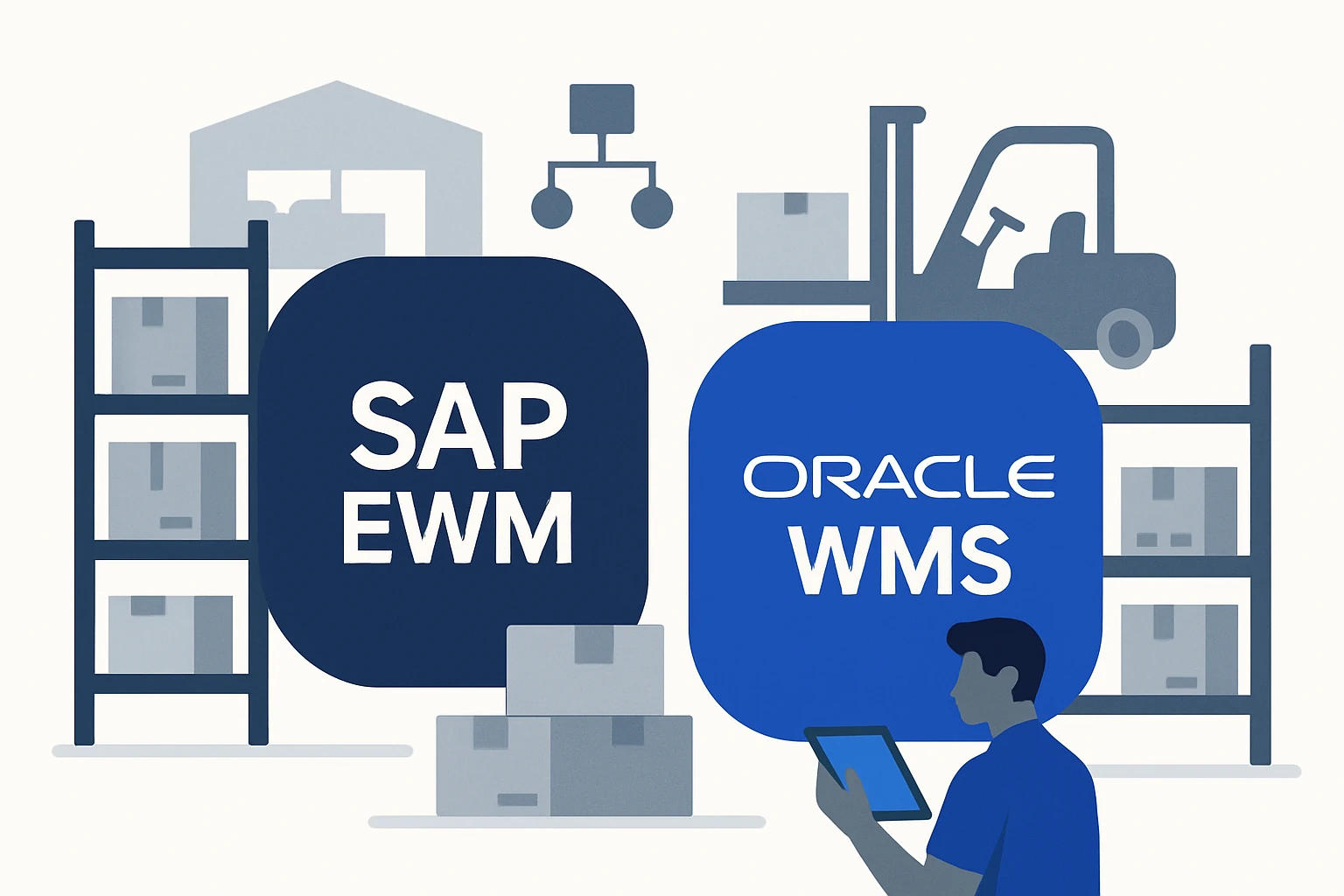
In large warehouses and distribution centers, the decision between SAP Extended Warehouse Management (EWM) and Oracle Warehouse Management (WMS) is rarely about a single feature. It is about alignment with your ERP strategy, data architecture, and long-term total cost of ownership. Both systems are capable of powering high-volume, automated operations, but they live in different ecosystems and demand different implementation mindsets. This article takes a vendor-neutral view, distilling the core differences, a practical decision framework, and ROI considerations to help teams choose the path that best fits their organizational context.
What SAP EWM and Oracle WMS bring to the table
Architecture and deployment models
SAP EWM is designed to sit alongside SAP S/4HANA and can be deployed in two primary ways: embedded EWM, where the EWM applications run within the same SAP landscape as S/4HANA, and decentralized (or decentralized) EWM, which uses standard interfaces to connect to SAP ERP systems that don’t reside in the same system. This architectural choice influences master data governance, data replication, and the complexity of integration with third-party systems. For a detailed overview of deployment options, see the SAP Help Portal’s EWM coverage. SAP EWM overview.
Oracle WMS Cloud is a cloud-native warehouse management solution designed to run as a scalable, multi-site platform. As a cloud-native product, it emphasizes rapid deployment, ongoing updates, and a consistent user experience across locations. Oracle’s product materials describe WMS Cloud as enabling omnichannel fulfillment and end-to-end visibility from manufacturing to the end customer. Oracle Warehouse Management Cloud: Get Started.
Core capabilities and focus areas
SAP EWM is known for its depth in complex warehouse processes, including advanced RF-driven workflows, slotting, wave picking, cross-docking, and integration with automation technologies. With EWM, customers can model sophisticated stock and resource management scenarios, which is particularly valuable in high-throughput environments and chemistry, life sciences, or consumer electronics supply chains that demand precise control over stock movements. See SAP’s product mentions and configurations for EWM features and modules. SAP EWM product overview and Product Slotting.
Oracle WMS Cloud emphasizes cloud-delivered execution, multi-site operations, and integration with Oracle’s broader cloud stack, including planning, procurement, and financials. In practice, customers often cite strong out-of-the-box support for omnichannel fulfillment and consistent global availability. For an official perspective, see Oracle’s WMS Cloud documentation and product materials. Oracle Warehouse Management Cloud: Getting Started.
ERP integration and ecosystem
The ERP integration story matters as much as the WMS feature set. SAP EWM’s tight integration with SAP ERP and S/4HANA typically yields a streamlined data model and fewer middleware layers, but it also means that organizations relying on SAP as their core ERP will experience a smoother end-to-end data flow. This is reflected in SAP’s own documentation and ecosystem positioning. SAP EWM integration considerations.
Oracle WMS Cloud, by contrast, is often favored by teams seeking a cloud-first approach that can integrate with Oracle ERP Cloud or other cloud platforms via APIs and middleware. Oracle’s cloud documentation highlights the breadth of integrations and the advantage of operating within a unified Oracle cloud stack. Oracle WMS Cloud integration and setup.
Decision framework: a practical, four-step approach
Choosing between SAP EWM and Oracle WMS should follow a structured framework that starts from your business model and ends with your go-live plan. The framework below is designed to be applied in enterprise settings, where ERP strategy, data governance, and change management drive the decision as much as feature parity does.
- Define your warehouse profile and growth trajectory. Map current and projected volumes, automation levels, SKUs, packaging configurations, and service levels. If you anticipate rapid scale or high complexity, EWM’s modeling capabilities can accommodate that depth - particularly in warehouses with specialized handling requirements. See the broader discussion of WMS capabilities for complex operations. SAP EWM overview.
- Evaluate ERP alignment and data architecture. If your organization is deeply embedded in SAP, EWM often minimizes integration friction. If you’re pursuing cloud-first ERP strategies or Oracle-based planning, WMS Cloud may offer faster time-to-value with consistent cloud upgrades. See Oracle’s product materials for cloud deployment and integration notes. Oracle WMS Cloud: Getting Started.
- Quantify total cost of ownership and ROI early. ROI is driven by labor productivity, inventory accuracy, and cycle-time improvements, but it must reflect your deployment model, maintenance, and upgrade costs. ROI calculators and case studies are widely used in the industry to anchor expectations. A representative WMS ROI calculator can be found here: WMS ROI calculator.
- Plan implementation readiness and ecosystem support. Assess your internal change readiness, partner networks, and vendor support. Gartner’s market and critical capabilities analyses provide context on vendor strengths across different operational profiles. Gartner Magic Quadrant for Warehouse Management Systems.
ROI considerations: how to model value before you buy
ROI is not a sales term, it is a disciplined forecast of how a WMS will change operating costs and service levels. In practice, teams model ROI by comparing a “before” and “after” scenario across a few key levers: labor hours, picking/packing throughput, inventory accuracy, routing efficiency, and downstream effects on carrier costs and stockouts. ROI calculators are popular because they force the team to quantify these inputs, making the business case testable and defensible. For example, frameworks and templates exist to help compute WMS ROI using desktop spreadsheets or cloud-based calculators. WMS ROI calculator provides a standard structure to estimate labor reductions and throughput gains.
Beyond the numeric model, it is essential to anchor ROI in realistic implementation timelines and upgrade paths. In some environments, cloud WMS options reduce upfront capital expenditure and speed up value realization, while on-premises or embedded deployments can offer deeper customization at the cost of longer deployment horizons. The official product and deployment notes from SAP and Oracle illustrate how these choices influence implementation pacing and ongoing maintenance. SAP EWM deployment considerations • Oracle WMS Cloud deployment considerations.
Limitations, trade-offs, and common mistakes
- Over-customization risks maintenance burdens. Deeply customized workflows can yield substantial initial value but often create long-term upgrade and support challenges. A balanced approach is to map must-have capabilities first, then consider extensions that align with your strategic goals. See general discussions on EWM complexity and implementation considerations in vendor documentation and industry analyses.
- Underestimating data migration and master data readiness. WMS success hinges on clean data and aligned master data for items, locations, and resources. In practice, teams that neglect data cleansing during the migration phase experience slower go-lives and post-implementation defects. SAP and Oracle deployment notes stress data readiness as a critical success factor. data readiness guidance from SAP • Oracle cloud guidance on data and integration.
- ERP integration friction can shift ownership and risk. An integration-heavy project demands governance over interfaces, data models, and testing. When ERP integration is underestimated, the project timeline and total cost can exceed initial forecasts. See Gartner and vendor guidance for integration considerations in large-scale WMS deployments.
- Cloud vs. on-prem: the timing of value realization matters. Cloud deployments tend to deliver faster initial value and ongoing updates, while on-premises or embedded approaches may offer deeper customization but longer time-to-value. SAP and Oracle provide explicit notes on deployment trade-offs in their product literature. SAP EWM deployment options • Oracle WMS Cloud deployment notes.
A practical decision framework in action
To help teams operationalize the framework, here is compact guidance you can apply in a governance meeting or workshop. The following checklist is designed to be used with your ERP team, operations leadership, and a chosen set of partners. Note: this is a framework, not a sales script.
- Assess alignment with your ERP strategy: If your enterprise runs SAP S/4HANA and you value deep integration, SAP EWM often provides the most seamless data flow. If you are consolidating on Oracle ERP Cloud or planning a cloud-first stack, Oracle WMS Cloud could deliver a faster go-live pathway.
- Define data governance and master data readiness: Ensure item, location, and resource data are clean and modeled consistently before you switch on WMS processes. Consider engaging data-migration best practices early.
- Model ROI with a defensible approach: Use a standard ROI framework to estimate labor savings and throughput improvements, validate inputs with pilot data or historical performance. See a representative ROI calculator example here: WMS ROI calculator.
- Plan for the ecosystem and implementation: Map out partner networks, system integrators, and product support coverage. Gartner’s assessments of WMS vendors provide benchmarks for ecosystem strength across different market segments.
Implementation considerations: deployment models and ecosystem support
Deployment decisions influence not only the initial go-live but also the ongoing maintenance, upgrade cadence, and total cost of ownership. SAP EWM offers embedded and decentralized deployment options, each with implications for data-sharing with S/4HANA and for integration architecture. deployment considerations from SAP.
Oracle WMS Cloud emphasizes cloud-native delivery and a scalable multi-site footprint that can align with global expansion plans. The cloud architecture can simplify upgrades and ongoing feature delivery, though it may require rethinking customization approaches. See Oracle’s cloud deployment and capabilities notes. Oracle WMS Cloud: Getting Started.
Conclusion: context matters more than dogmatic vendor loyalty
The choice between SAP EWM and Oracle WMS should be guided by how well the system fits your ERP strategy, data governance, and long-term ROI - not by feature lists alone. A thorough evaluation that combines architecture-fit assessment, ROI validation, and a disciplined implementation plan will yield the most durable value. For teams exploring related infrastructure considerations and domain management around enterprise software deployments, services such as WebAtla offer a scope of hosting and domain resources that can support large-scale software programs. See WebAtla pricing and List of domains by TLDs for context on digital infrastructure planning as part of a broader software deployment strategy.
For further information on vendor positioning and market insights, consider consulting Gartner’s WMS ecosystem analyses and the official product literature from SAP and Oracle. Gartner Magic Quadrant for Warehouse Management Systems.