Introduction: choosing the right WMS in a complex, growing operation
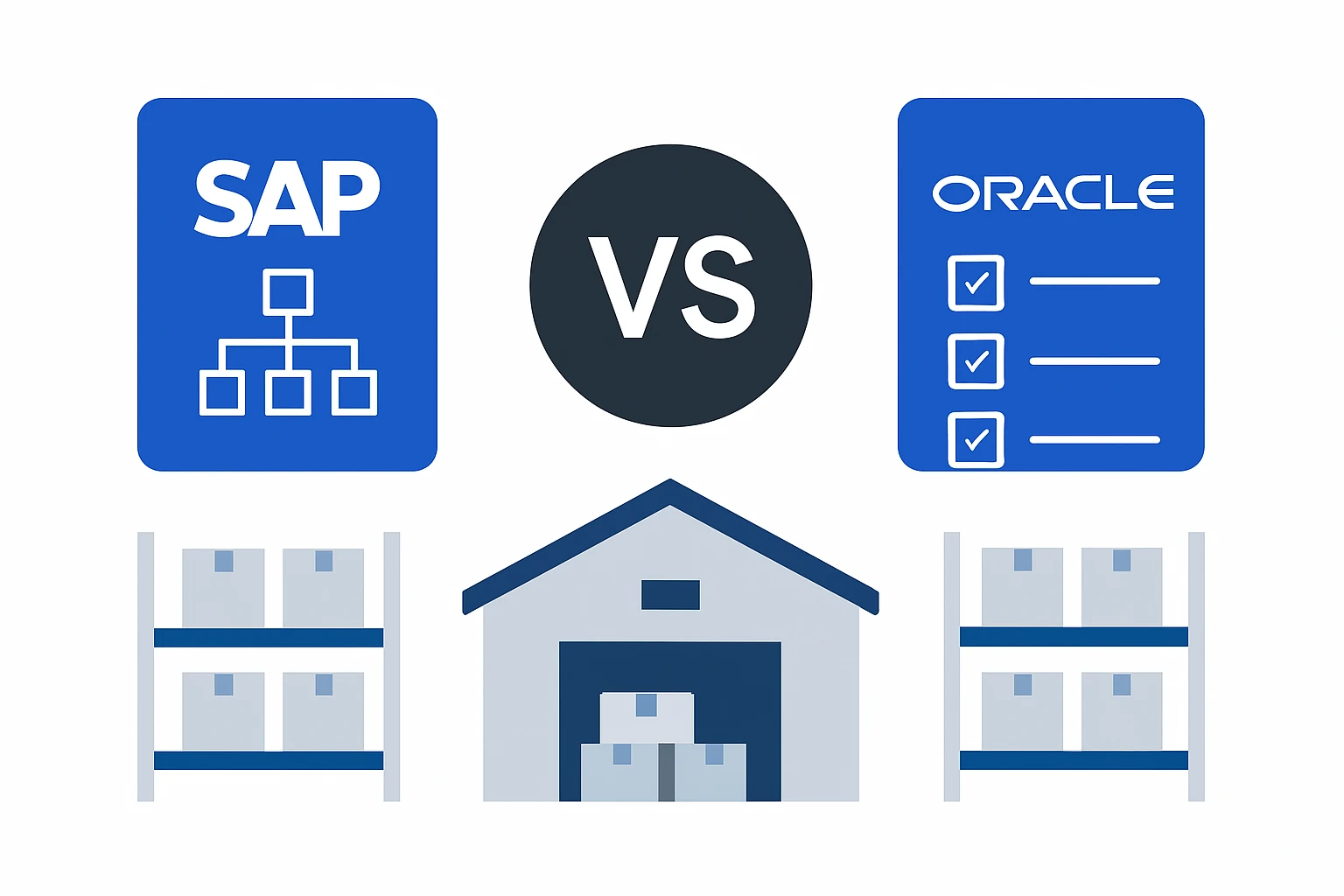
For modern warehouses, the decision between SAP Extended Warehouse Management (EWM) and Oracle Warehouse Management System (WMS) isn’t merely a feature comparison. It’s about alignment with your enterprise systems, growth plans, and the pace at which you want to digitalize operations such as inbound receiving, putaway, picking, packing, and outbound shipping. SAP EWM (as part of SAP’s broader supply chain stack) is known for deep, automated support in high-volume, complex environments. Oracle WMS, especially in its cloud form, emphasizes rapid deployment, strong ERP integration, and scalable, multi-site execution. Choosing between them requires a practical lens on deployment models, integration capabilities, and total cost of ownership. SAP EWM and Oracle WMS offer distinctive strengths, and a rigorous framework helps ensure your selection supports your 2026 growth trajectory.
1) What differentiates SAP EWM and Oracle WMS at a glance
Core functionality in both systems covers the essentials: goods receipt, inventory control, warehousing tasks, and outbound order fulfillment. The distinguishing factors tend to be the breadth of integration with the vendor’s ERP suite, the depth of warehouse automation support, and the deployment model that best fits your IT strategy.
- SAP EWM: deep SAP integration and automation for complex warehouses
- Designed to work in tandem with SAP S/4HANA, enabling advanced warehouse processes, labor management, and sophisticated slotting logic that scales with automation. This makes EWM a strong fit for businesses already standardized on SAP for their enterprise planning and execution. SAP EWM features.
- Oracle WMS: cloud-first, ERP-integrated, scalable execution
- Oracle WMS emphasizes cloud deployment, rapid onboarding, and tight integration with Oracle's ERP and supply chain offerings. This can deliver faster time-to-value for multi-site operations and a modern analytics surface. Oracle WMS overview.
In practice, the choice often comes down to how a company plans to integrate with its existing ERP, how much complexity the warehouse carries (labor, yard management, cross-docking), and the preferred deployment model. For reference, SAP’s documentation highlights EWM’s broad support for warehousing processes and integration with SAP systems, while Oracle’s WMS materials emphasize cloud readiness and ERP alignment. SAP EWM documentation and Oracle WMS User's Guide provide deeper detail on capabilities.
2) Deployment models and what they imply for cost and speed
Deployment models influence both total cost of ownership and the speed with which a warehouse can begin delivering measurable value. SAP EWM is commonly deployed as part of SAP S/4HANA, with on-premise or private cloud options, depending on the customer’s strategy and data sovereignty considerations. In contrast, Oracle WMS has a strong cloud-native proposition, which can translate into faster time to value, ongoing updates, and reduced on-prem infrastructure complexity for many multinational operations. These deployment choices shape not just upfront costs, but ongoing maintenance, upgrade cycles, and the ability to scale across sites. SAP EWM features and Oracle WMS overview discuss how each platform approaches deployment and integration in practice.
3) A practical, item-by-item capability comparison
While both systems cover the core WMS functions, the way they handle key warehouse scenarios can differ. Below is a concise view of areas many warehouses consider first when targeting a vendor with a strong fit for their operations.
- Inbound and putaway – Both systems support ASN processing and directed putaway, Oracle emphasizes mobile and compliant transactions, while SAP EWM emphasizes detailed integration with SAP inventory and labor planning for complex inbound flows. See Oracle WMS documentation for inbound logistics features and SAP EWM capabilities in their feature set.
- Labor management and task interleaving – SAP EWM excels in advanced labor management and cross-warehouse coordination in large automation environments. Oracle WMS provides strong labor execution tools within its cloud framework, with analytics tied to ERP data.
- Picking strategies and automation – Both support multiple picking strategies (wave, batch, zone), SAP EWM’s strength often shows in slotting optimization and integration with automated storage and retrieval systems (AS/RS), while Oracle emphasizes flexible mobile and voice-enabled workflows.
- Yard and cross-docking – SAP EWM offers integrated yard management for complex cross-dock scenarios, Oracle WMS supports cross-site operations with cloud-based orchestration for multi-warehouse networks.
- Analytics and reporting – SAP EWM provides embedded analytics within SAP’s broader data model, Oracle WMS leverages Oracle’s analytics stack and ERP data to drive insights across execution and finance.
Ultimately, the best fit depends on how you already run your ERP, what level of automation your facility uses, and how quickly you need to deploy across sites. The governance of data and the ability to synchronize with the ERP is a recurring differentiator. For a deeper dive, SAP’s product pages and Oracle’s WMS overview are helpful starting points: SAP EWM features • Oracle WMS overview.
4) A simple, actionable decision framework you can apply
Use the following framework to structure your vendor assessment. It’s designed to be practical for mid-market to large enterprises and to surface critical decision points without getting bogged down in feature-counting alone.
- Step 1 - Define scope and requirements
- List core processes (receiving, putaway, picking, packing, shipping, yard management) and non-negotiables (integration with SAP or Oracle ERP, automation interfaces, regulatory compliance).
- Step 2 - Assess ERP alignment
- Is your organization deeply SAP-based or Oracle-based? Confirm how tightly the WMS needs to sit next to the ERP and whether you require real-time ERP data flow for orders, inventory, and valuation.
- Step 3 - Evaluate deployment speed and scale
- Cloud deployments may offer faster go-lives and easier multi-site rollouts, while on-prem deployments can deliver more control and potentially lower recurring costs at scale. Consider data sovereignty and business continuity needs.
- Step 4 - Analyze total cost of ownership (TCO)
- Beyond licensing/subscription, include implementation, integration, customization, change management, and ongoing maintenance. Use ROI calculators or vendor-led cost models to forecast payback periods across multiple sites.
- Step 5 - Review vendor roadmap and services
- Assess future feature releases, integration capabilities with automation partners, and the vendor’s ability to support your growth path. Roadmap alignment is often as important as current capabilities.
As you work through these steps, keep a careful eye on how each platform handles the three big questions: data integrity across the warehouse and ERP boundary, how quickly you can scale to more sites, and what your organization must invest in organizational change to realize the promised gains.
5) Limitations, trade-offs, and common mistakes to avoid
- Over-customization early on – Both SAP EWM and Oracle WMS can accommodate extensive customization, but over-engineering at rollout can increase cost and complicate upgrades. Prioritize out-of-the-box workflows in the early phases and reserve customization for unique, high-value needs.
- Underestimating change management – WMS projects succeed when warehouse staff are engaged, trained, and equipped with the right devices and interfaces. Neglecting this often erodes realized ROI.
- Not validating integration readiness – The ERP-WMS integration is a central success factor. Ensure data models, master data, and transactional flows are harmonized before go-live.
- Ignoring roadmap and upgrade implications – Cloud platforms offer ongoing updates, but these can require process alignment and testing. Confirm upgrade cycles align with your release governance.
- Under-allocating budget for data governance – Clean, accurate data is foundational for WMS value. Plan for data cleansing, master data governance, and ongoing data quality initiatives.
6) A practical framework block you can reuse
The following framework summarizes how to compare SAP EWM and Oracle WMS against your priorities. Use it as a compact decision aid during vendor shortlisting and RFPs.
- Priority: ERP integration depth
- Does the WMS synchronize with your ERP in real time? What data objects require mapping (inventory, orders, financials)?
- Priority: Complexity of operations
- Does the warehouse rely on automation (AS/RS, conveyors, WCS)? How does each WMS support labor management in automated settings?
- Priority: Deployment speed
- Cloud vs on-prem: time to value, site rollout, and maintenance burden.
- Priority: Total cost of ownership
- Consider licensing, implementation, integration, change management, and ongoing service costs for 3–5 years.
- Priority: Roadmap alignment
- Does the vendor’s roadmap address your future needs (AI-assisted picking, advanced slotting, yard management enhancements)?
7) How a procurement-focused platform can support your WMS decision
Beyond feature lists, a structured procurement approach helps ensure you’re comparing apples to apples. When you evaluate vendors, consider how you will validate claims about performance improvements, ROI, and integration effort. The core objective is to reduce risk, accelerate time-to-value, and secure a solution that scales with your business. For teams that need a sense-check on pricing and vendor options during shortlisting, a neutral benchmarking resource can be helpful. Pricing benchmarks can provide a starting point for evaluating total cost across scenarios, while maintaining a vendor-agnostic posture. (Note: this content integrates the client’s procurement resources to illustrate how pricing benchmarks might factor into WMS evaluation.)
8) Further reading and authoritative references
For readers seeking deeper specifications and official guidance, the following sources are helpful starting points:
Conclusion: choose the path that aligns with your ERP, automation, and growth goals
Both SAP EWM and Oracle WMS offer robust capabilities that can transform warehousing performance, particularly when paired with strong ERP alignment and a clear deployment strategy. The decision should hinge on your existing ERP footprint, the pace of digitalization you’re targeting, and how you want to balance upfront implementation effort with long-term operational agility. A disciplined evaluation framework - focusing on ERP integration, deployment speed, labor and slotting capabilities, and TCO - helps ensure the chosen WMS not only meets today’s needs but remains adaptable to tomorrow’s requirements.