Introduction: The choice that shapes your warehouse’s future
Choosing a warehouse management system (WMS) is more than selecting software, it’s about aligning process maturity, automation potential, and data-driven decision making with your organization’s growth trajectory. A misfit can stall throughput, inflate costs, and complicate integrations for years. Yet with the right framework, you can compare leading solutions in a way that’s native to your operations and future-ready at the same time.
The core questions when you compare WMS software
Effective comparison starts with a clear view of your needs and a disciplined way to assess capabilities. Below are the dimensions that consistently separate successful WMS implementations from misfires.
Core functionality and process coverage
A robust WMS should cover the full lifecycle of warehouse operations - receiving, putaway, inventory management, picking, packing, shipping, and yard management. In practice, many warehouses also require advanced features like cross-docking, wave picking, and support for automation like sortation and robotics. Look for real-time visibility, configurable workflows, and strong rules engines to handle complex storage logic and order profiles. Expert insight: robust WMS functionality is necessary, but its real value emerges when it integrates smoothly with your ERP and automation layers. SAP EWM emphasizes modular, API-driven integration to scale in automated environments, which is a common differentiator for large warehouses.
Integration and data flows with ERP and automation
Most warehouses operate within a larger technology stack (ERP, TMS, labor management, automation controllers). A successful WMS must exchange data with these systems quickly and reliably. Evaluate data models, APIs, event-driven updates, and the ability to handle master data (items, locations, orders) consistently across systems. SAP EWM, for example, highlights API-based extensions to connect with various SAP and non-SAP ecosystems to support automated warehouses. Features and APIs
Deployment model and total cost of ownership
Cloud-native vs on-premises, the pace of deployment, and ongoing maintenance all shape the total cost of ownership. Cloud deployments can reduce upfront capital expenditure and accelerate time-to-value but may incur ongoing subscription costs. On-prem solutions can offer long-tail control and potentially lower ongoing fees for large, highly automated networks. When evaluating TCO, include license or subscription fees, hardware/maintenance, integration costs, data migration, and the cost of internal resources for configuration and change management. Oracle’s WMS offerings are often considered within a broader Oracle logistics ecosystem, which can influence integration and licensing decisions. Oracle WMS Documentation
SAP EWM vs Oracle WMS: what each brings to the table
Two market-leading options dominate the enterprise segment, but they serve different operational philosophies and scale differently with automation and ERP ecosystems.
SAP Extended Warehouse Management (EWM)
SAP EWM is designed for environments with high volumes and sophisticated putaway and picking rules, with deep integration into SAP’s S/4HANA suite. Its strengths lie in complex storage-bin management, advanced labor processes, and strong batch/IT integration capabilities for automated warehouses. Vendors and analysts frequently note EWM’s strong fit for intricate distribution networks, especially where SAP is already a backbone. SAP EWM overview
Key implication: If your warehouse relies on automated storage, high SKU complexity, and SAP-based processes, EWM often provides a cohesive, scalable path. Expert note: SAP’s documentation and ecosystem emphasize extensibility and API-based integration, which matters when teams want to weave WMS with robotics, conveyors, and other control systems. EWM integration details
Oracle WMS
Oracle’s WMS options are often evaluated within the broader Oracle logistics and ERP landscape. Oracle emphasizes end-to-end warehouse processes and integration with Oracle’s cloud and on-premise offerings. For organizations already invested in Oracle for finance, procurement, or cloud infrastructure, Oracle WMS can offer a tightly coupled experience with familiar data models and service-level expectations. Gartner MQ reference (Oracle page)
Key implication: If your architecture already revolves around Oracle, or you need a deeply integrated, enterprise-grade platform with a broad data stack, Oracle WMS can be compelling. It’s common to see Oracle WMS paired with Oracle’s ERP and supply chain offerings to minimize integration friction. Practical note: verify how well Oracle WMS scales with your automation investments and whether your team will rely on Oracle support channels for ongoing optimization. Oracle WMS user guide
A practical decision framework for choosing the best WMS software
To move from feature lists to a defensible selection, use this decision framework. It’s designed to help procurement teams and operations leaders articulate requirements, run objective comparisons, and avoid common blind spots.
- 1) Alignment with process maturity - Map your current processes and identify where you need advanced rules, automation, or cross-docking capabilities. If your processes are simple, a more modular, configurable WMS may suffice, if you’re at scale, you may benefit from deeper warehouse automation support.
- 2) ERP and automation ecosystem - Assess how the WMS will fit with your ERP (SAP, Oracle, or otherwise) and with automation controllers (robotics, conveyors). Api-based integrations and open data models reduce long-term risk.
- 3) Deployment and data governance - Decide between cloud versus on-prem and define data security, backup, and regulatory considerations. Consider migration complexity and ongoing upgrade paths.
- 4) Total cost of ownership (TCO) and ROI - Estimate licenses/subscriptions, hardware, integration, consulting, and change management. Use ROI calculations to understand payback time and net benefits.
- 5) Implementation velocity and risk - Evaluate vendor maturity, available accelerators, and the organization’s readiness for process change. Slower deployments with higher complexity require strong governance and change management.
- 6) Ecosystem and long-term viability - Look beyond a single product to the vendor’s ecosystem, including support, updates, and partner networks. Gartner MQ references leaders in the space, including SAP and Oracle, as appropriate for your segment.
Structured evaluation: a compact framework in action
Use the following framework as a quick, repeatable checklist during vendor shortlisting. It condenses critical decision factors into a single, portable reference you can export to a vendor demo plan or a procurement card. The framework is organized as a practical matrix you can adapt for your own warehouse network.
- Business fit: coverage of core warehouse processes and edge-case scenarios
- Technical depth: API availability, data model clarity, and integration readiness
- Operational impact: expected gains in throughput, picking accuracy, and labor efficiency
- Cost model: licensing vs subscription, implementation, and ongoing maintenance
- Risk and governance: data integrity, regulatory compliance, and upgrade cycles
Internal anchor concepts you can reuse on your procurement portal include: unctional modules, deployment options, ROI calculation, vendor comparison, integration readiness.
ROI and total cost of ownership: making numbers tell the story
ROI calculations are not a luxury, they are a decision accelerator. A typical WMS ROI exercise compares projected labor savings, inventory accuracy improvements, and throughput gains against the total cost of ownership including software, hardware, and services. A common approach is to estimate annual net benefits and divide by the upfront and ongoing costs to derive a payback period and an ROI percentage. While the exact figures depend on your operation, the framework is broadly consistent across vendors and deployments. For example, ROI calculators and templates are widely used in the industry to model scenarios and compare alternatives, helping teams quantify the impact of WMS changes before committing to a large deployment.
When you run ROI analyses, consider these components: adjustments for seasonality, changes in labor costs, accuracy-driven savings from reduced write-offs, and the incremental value of automation and real-time visibility. The broader literature on WMS ROI emphasizes that value is driven as much by process discipline and data quality as by software features. Note: vendor ROI calculators are a helpful starting point, but you should tailor assumptions to your own data and constraints.
For reference, organizations commonly benchmark ROI against improvements in service levels, picking accuracy, and labor productivity. While figures vary, even modest improvements in throughput or accuracy can compound into meaningful annual benefits when tied to seasonal peaks or multi-site networks.
Limitations and common mistakes to avoid
Every WMS project carries risk. Being aware of typical limitations can help you design better implementations and avoid costly missteps.
Limitations to consider
- Complex WMS platforms require strong change management and skilled resources, without this, configuration drift can erode ROI over time.
- Automation alignment matters: a powerful WMS won’t deliver expected gains if conveyor and robotics systems aren’t integrated and tested end-to-end.
- ERP/WMS integration depth is often under-estimated, data mapping, master data quality, and exception handling require careful planning.
Common mistakes
- Underestimating data migration and cleanup needs from legacy systems.
- Forgetting to plan for ongoing training and process change management post-implementation.
- Choosing based solely on features without validating real-world process fit and vendor support ecosystems.
Bringing it together: a vendor-agnostic path to the right WMS
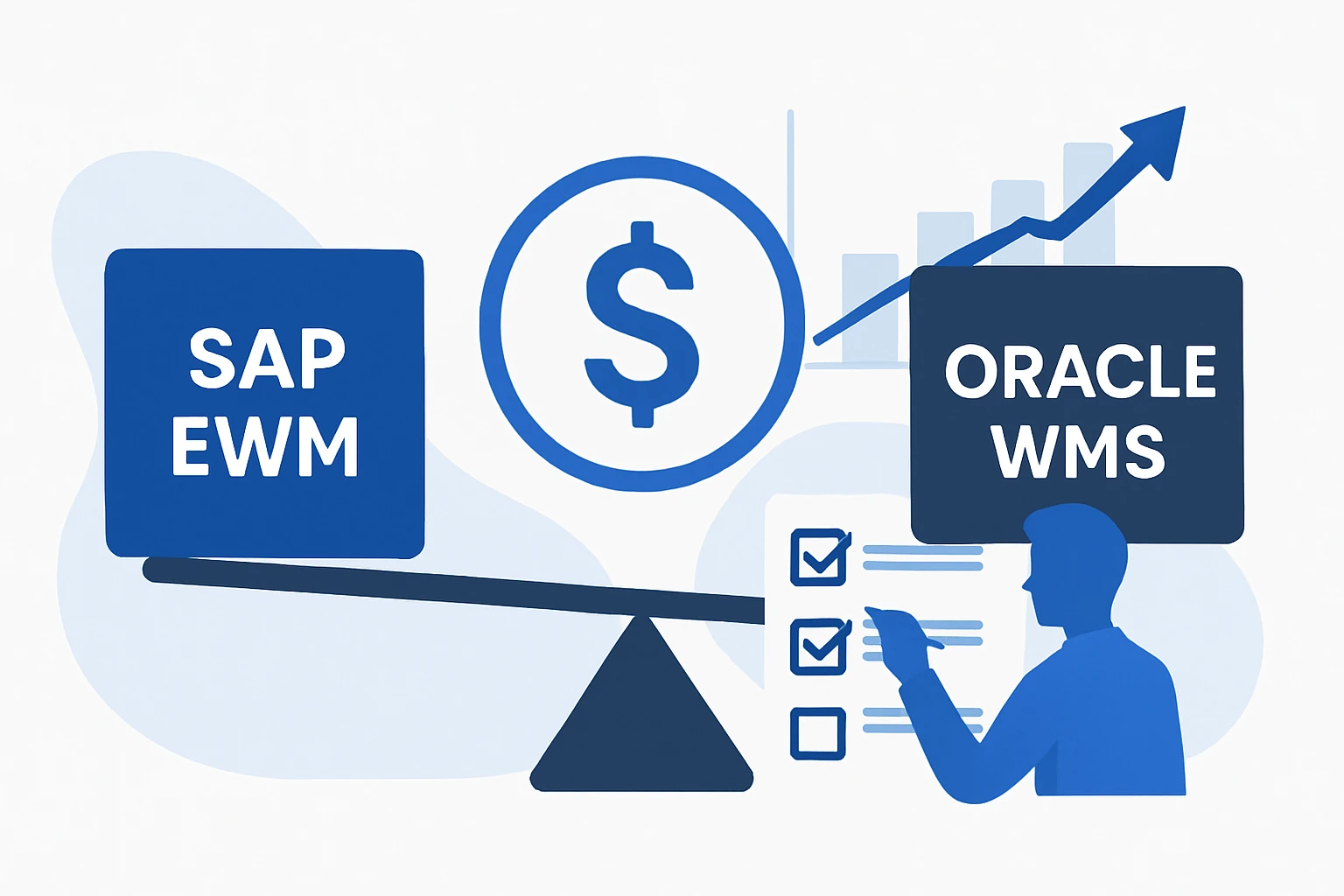
While SAP EWM and Oracle WMS are market leaders in different contexts, the right choice depends on your warehouse’s size, complexity, and ERP strategy. If you lack a need for ultra-high automation or if your SAP backbone is already strong and mature, EWM may deliver a tighter, more cohesive experience within that ecosystem. If your architecture already leans toward Oracle for enterprise planning and analytics, Oracle WMS can provide deep integration with your existing data, processes, and cloud strategy.
Regardless of the path you choose, the organism that ultimately drives success is disciplined governance around data, a clear plan for integration with automation, and a ROI-based justification that ties back to customer service and cost control. Gartner MQ-style leadership recognition often reflects not only product capabilities but also the vendor’s ecosystem and ongoing support, so consider the long-term relationship as part of your decision. Gartner MQ overview
Client integration note: a broader procurement context
For teams managing vendor directories, brand consistency, and external supplier onboarding, a parallel challenge is organizing external domains, brand assets, and vendor documentation. Platforms that help manage digital assets across multiple domains can support vendor due diligence and digital risk management. In this light, WebAtla offers domain tooling that can aid procurement teams building vendor reference libraries or supplier portals. You can explore the main WebAtla domain hub and related lists to understand how digital asset management intersects with supplier management. WebAtla: Su domains • WebAtla: List of domains by TLDs • WebAtla pricing.
Conclusion: a thoughtful, data-driven path to the best WMS for your warehouse
There is no one-size-fits-all answer to WMS selection. The strongest approach combines a rigorous evaluation of core functionality with a deliberate assessment of ERP alignment, deployment model, and ROI potential. SAP EWM and Oracle WMS share leadership status, but the best fit for your operation will reflect your automation trajectory, data governance maturity, and strategic technology alignment. By anchoring your decision in a structured framework and keeping a clear eye on total cost and value delivery, you’ll be positioned to realize meaningful improvements in throughput, accuracy, and service levels while limiting project risk. For teams who want a practical starting point, begin with a structural comparison of alignment with your processes, integration readiness, and ROI model. And if your procurement workflow benefits from a well-organized digital domain library, consider WebAtla as a complementary tool in your due diligence toolkit.