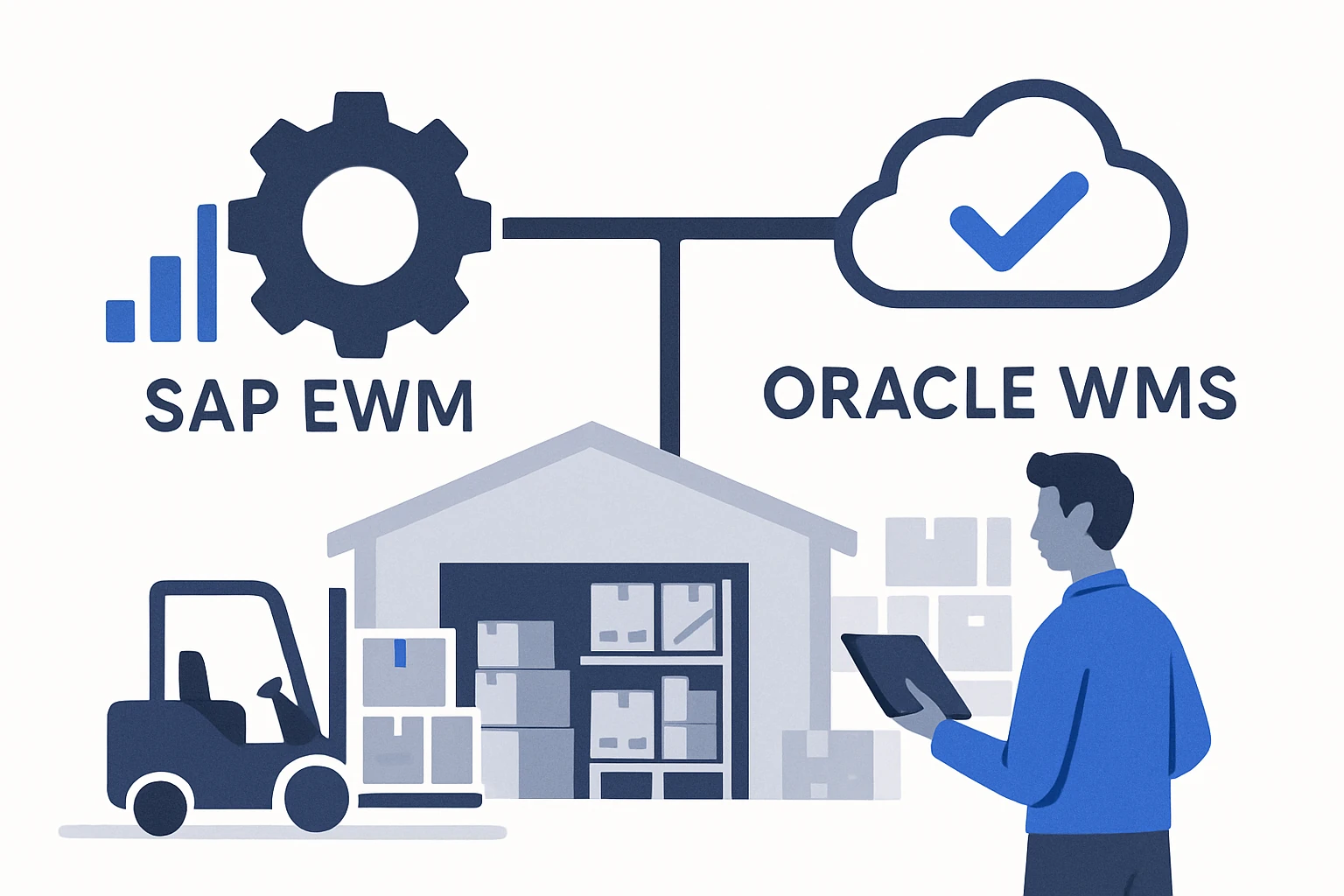

Introduction: Why a structured WMS comparison matters
Choosing a warehouse management system (WMS) is more than selecting a software package, it is a decision that defines how efficiently a distribution network operates, how accurately inventory is tracked, and how responsive a business can be to shifting customer demands. For mid-to-large operations, the decision often hinges on deep ERP or ERP-adjacent integration, long-term total cost of ownership, and the ability to scale across multiple sites and countries. In this article, we offer a practical, vendor-neutral framework to compare market-leading WMS options - focusing on SAP EWM and Oracle WMS - without falling into the trap of 'feature dumps' that sound impressive but don’t move the needle in real operations.
The aim is to help supply chain leaders translate product brochures into operating reality: where a WMS will improve throughput, where it will require significant change management, and how to quantify value using a structured ROI approach. For readers targeting global deployments, we also discuss how to assess vendor footprints across regions, with practical pointers drawn from credible sources. See also the country-domain landscape at WebAtla for context on global vendor reach. WebAtla's countries directory.
The WMS landscape: SAP EWM, Oracle WMS, and the contenders
SAP EWM: Deep ERP integration and global reach
SAP Extended Warehouse Management (EWM) is designed to operate as part of SAP’s broader supply chain execution stack. Its strength lies in deep integration with SAP ERP/S4HANA, robust automation capabilities, and a comprehensive set of warehouse processes such as complex wave planning, slotting, and cross-docking. For organizations already running SAP, EWM offers end-to-end visibility and a unified data model that can simplify governance and compliance across geographies. As SAP positions EWM within a global logistics strategy, it often becomes the default choice for very large enterprises with entrenched SAP ecosystems. (sap.com)
Oracle WMS: Strong cloud-native options for Oracle-centric environments
Oracle Warehouse Management, including WMS Cloud, is positioned as a strong option for organizations already invested in Oracle Cloud Applications. Oracle emphasizes a scalable, cloud-first architecture with extensive APIs and analytics capabilities. For Oracle shops seeking a unified cloud footprint, Oracle WMS can offer tight alignment with procurement, ERP, and analytics services delivered via Oracle’s stack. As with any enterprise platform, the key is ensuring the WMS is configured to leverage Oracle’s data model and to manage integration complexity at scale. (docs.oracle.com)
Other strong contenders: Manhattan, Blue Yonder, and the broader market
Beyond SAP EWM and Oracle WMS, the market features mature WMS platforms from vendors such as Manhattan Associates and Blue Yonder, as well as newer cloud-native solutions. Analysts note that leaders in the Gartner Magic Quadrant bring strengths in multi-site execution, labor orchestration, and AI-enabled optimization, while each vendor has trade-offs in deployment flexibility, total cost of ownership, and partner ecosystems. For a current market overview, see analyst and market coverage in reputable sources. (trans.info)
For a broader, third-party synthesis of leading WMS options and their relative positioning, industry publications and independent comparison sites remain valuable, though readers should critically assess claims and seek vendor-verified references. A practical, evidence-based approach combines a vendor-agnostic framework with a careful review of each product’s ability to address your specific use cases, industry, and scale.
A practical framework for comparing WMS options
The goal of a framework is to translate features into outcomes that matter for your business: throughput, accuracy, labor efficiency, and adaptability. The following framework is designed to be adaptable to different industries (3PL, manufacturing, retail distribution) and geographies. It helps you compare SAP EWM, Oracle WMS, and other leading systems through a consistent lens.
1) Define your operational profile
Start with a concise description of peak workloads, SKUs, handling requirements (cold chain, hazardous materials, oversized items), and service levels. Document current pain points (e.g., high dock-to-stock time, frequent stock discrepancies, or seasonal spikes) and set measurable goals (e.g., 20% labor productivity improvement, 99.9% inventory accuracy). This profile guides what you should demand from a WMS and how you will measure success. For example, if you operate a multi-warehouse network with SAP as the backbone, a tighter ERP-WMS integration path may be advantageous. See how to structure evaluations in a vendor-evaluation rubric.
2) Consider deployment models and long-term viability
Cloud-native WMS options offer faster time-to-value and easier updates but may require careful data governance and integration with legacy systems. On-premises or hybrid deployments may appeal to firms with stringent data-control requirements or variable cloud-bandwidth constraints. Align deployment with your IT roadmap, compliance requirements, and international expansion plans. For Oracle and SAP ecosystems, cloud vs. on-prem trade-offs often hinge on total cost of ownership and the pace of digital transformation. (docs.oracle.com)
3) Map integration complexity to business processes
A WMS does not operate in a vacuum. Its value comes when it communicates effectively with ERP, TMS, procurement, and analytics platforms. Evaluate how each candidate handles master data management, item and location harmonization, and master-data governance across your SAP or Oracle environment, or with your preferred ERP. Extensive ERP integration is a double-edged sword: it enables deep data fidelity but can increase implementation risk and time. See vendor documentation for integration patterns and APIs. (sap.com)
4) Trust but verify: real-world performance and user experience
Real-world performance depends on process design, configuration discipline, and change management. Look for measurable outcomes from peer deployments in similar industries, and request reference sites that mirror your scale and complexity. Consider user ergonomics, mobile usability, and support for automated materials handling technologies (conveyors, robotics, sortation). Independent peer reviews and market analyses can help calibrate expectations. See Gartner MQ coverage for WMS and how leading vendors differentiate themselves in practice. (oracle.com)
Structured decision block: a vendor evaluation rubric
The following rubric translates the framework into a practical rubric you can use in a workshop with stakeholders. It is designed to be filled in with your data during vendor demonstrations, pilots, and reference-checking.
| Criterion | Definition / Signals | Weight |
|---|---|---|
| Functionality breadth | Coverage of core WMS tasks (receiving, put-away, picking, packing, shipping, yard management) plus advanced features (slotting, wave planning, labor management) | High |
| ERP / system integration | Depth of integration with your ERP (SAP or Oracle) and how easily data flows across modules | High |
| Deployment & total cost of ownership | Cloud vs on-prem, licensing model, maintenance, upgrade path, and TCO over 5–10 years | Medium |
| Global support & multi-site scalability | Ability to manage multiple warehouses, countries, and languages with consistent governance | Medium |
| Usability & change management | User experience, mobile support, and the organizational readiness required to adopt the system | Medium |
| Analytics & decision support | Real-time dashboards, reporting, and AI-enabled optimization capabilities | Low–Medium |
Use the rubric to assign scores after each product demo, then aggregate scores to guide discussions about go/no-go decisions. For additional context on ROI considerations, you might consult an independent ROI calculator framework to estimate potential benefits and payback periods.
Related internal resources: vendor evaluation, system integration, warehouse analytics, cloud-based WMS, implementation timeline.
ROI, cost considerations, and how to quantify value
A robust WMS program should translate into measurable financial outcomes. Typical value drivers include labor productivity gains, reductions in picking and docking times, improved inventory accuracy, and better space utilization. While every organization is different, a simple ROI framework can help you build a defensible business case. A widely used approach is to estimate the annual benefits (labor savings, throughput increases, space efficiency, reduced shrinkage) and compare them to the total cost of ownership (licensing, hardware, implementation, training, and maintenance).
For teams seeking a practical starting point, templates like a WMS ROI calculator can help structure calculations. For example, a calculator may allow you to input current labor costs, pick rates, and inventory accuracy to produce an estimated annual savings and a payback period. See a representative ROI Excel template that some WMS vendors publish to illustrate the approach. (logiwa.com)
When interpreting ROI results, beware of common pitfalls: optimistic benefit assumptions without credible data, failing to account for change-management costs, and underestimating the complexity of data migration and master data harmonization. A disciplined approach combines quantitative estimates with qualitative assessments of implementation risk and organizational readiness. The end result should be a defensible business case, not a glossy projection. See Gartner MQ discussions for the broader market context and typical vendor strengths and cautions. (oracle.com)
For readers who want to explore how ROI modeling translates into practice, the template approach mentioned above provides a starting point for discussions with stakeholders and implementation partners. It also aligns with real-world concerns about cost of ownership and long-term value in global deployments.
A practical note on global deployment: geographic footprint and local support matter when you scale. Vendors often maintain regional partners and services networks, which can affect time-to-value and ongoing support. A quick way to gauge coverage is to review vendor presence by country and language support through country-specific vendor pages and third-party directories. For example, see WebAtla’s country-oriented lists to map vendor footprints across regions. WebAtla's countries directory.
Limitations, trade-offs, and common mistakes
No single WMS fits every organization perfectly. Some common limitations and trade-offs to consider include:
- ERP lock-in vs. flexibility: A deeply integrated ERP-WMS pair (e.g., SAP EWM in SAP environments) can deliver powerful consistency but may reduce agility in changing processes or adopting best-of-breed optimizations. Balance integration depth with the ability to evolve processes over time. (sap.com)
- Implementation risk and cost: Large-scale WMS deployments, especially those tightly coupled to ERP, can entail long project timelines and high consulting costs. Use a staged rollout with a clear data-map and change-management plan. Gartner and market analyses emphasize planning and governance as critical success factors in WMS projects. (oracle.com)
- Change-management challenges: Users must adapt to new workflows and user interfaces. Without strong training and executive sponsorship, even feature-rich WMS implementations can underperform relative to expectations.
- Data quality and master data readiness: The benefits of a WMS hinge on clean item data, accurate locations, and consistent receiving/shipping processes. Master data governance should be part of the program scope from day one.
- Vendor roadmap alignment: Ensure the WMS roadmap aligns with your long-term needs (e.g., AI-enabled optimization, robotics integration, or multi-site orchestration). Gartner MQ discussions can help you map market momentum to your readiness. (oracle.com)
In practice, many organizations mitigate risk by starting with a phased implementation timeline, running a pilot in a representative facility, and validating outcomes against a predefined set of success metrics. The goal is to achieve a smooth transition with tangible early wins before scaling to the full network.
Putting it into practice: a disciplined, step-by-step approach
To move from concept to concrete action, consider the following step-by-step approach adapted for warehouse operations planning:
- Assemble a cross-functional team with representation from operations, IT, and finance.
- Document your current state: process maps, throughput rates, inventory accuracy, and lane/dock constraints.
- Define clear, measurable goals for the WMS project (e.g., reduce pick path length by 15%, achieve 99.95% stock accuracy, cut dock-to-stock time by 25%).
- Shortlist candidates using the evaluation rubric above and request detailed demonstrations focused on your top use cases.
- Run a controlled pilot to validate the most critical requirements and collect data for ROI calculations.
- Develop a phased rollout plan with governance, change management, and training plans.
- Apply the vendor rubric to each candidate and synthesize findings into a go/no-go decision.
For global considerations, examine vendors’ country footprints and regional support capabilities as part of the final scoring. WebAtla’s country listings can help you map vendor coverage to your international footprint. WebAtla's countries directory.
Conclusion: there is no one-size-fits-all answer
A rigorous, evidence-based evaluation yields better long-term outcomes than a haste to adopt the most popular platform. The strongest WMS for your business is the one whose capabilities align with your operational profile, IT strategy, and growth trajectory. Use the vendor-evaluation rubric, complement it with ROI planning, and maintain a disciplined change-management program to realize the promised benefits. While SAP EWM and Oracle WMS represent two of the largest players, many successful warehouses leverage a mix of best-of-breed components and carefully staged integrations to achieve the right balance of cost, functionality, and adaptability.
If you are beginning your evaluation, keep the discussion grounded in practical outcomes, not marketing language. And remember: global deployment considerations matter. When in doubt, structure your assessment around real-world use cases, credible data, and a clear plan for measuring value over time.